

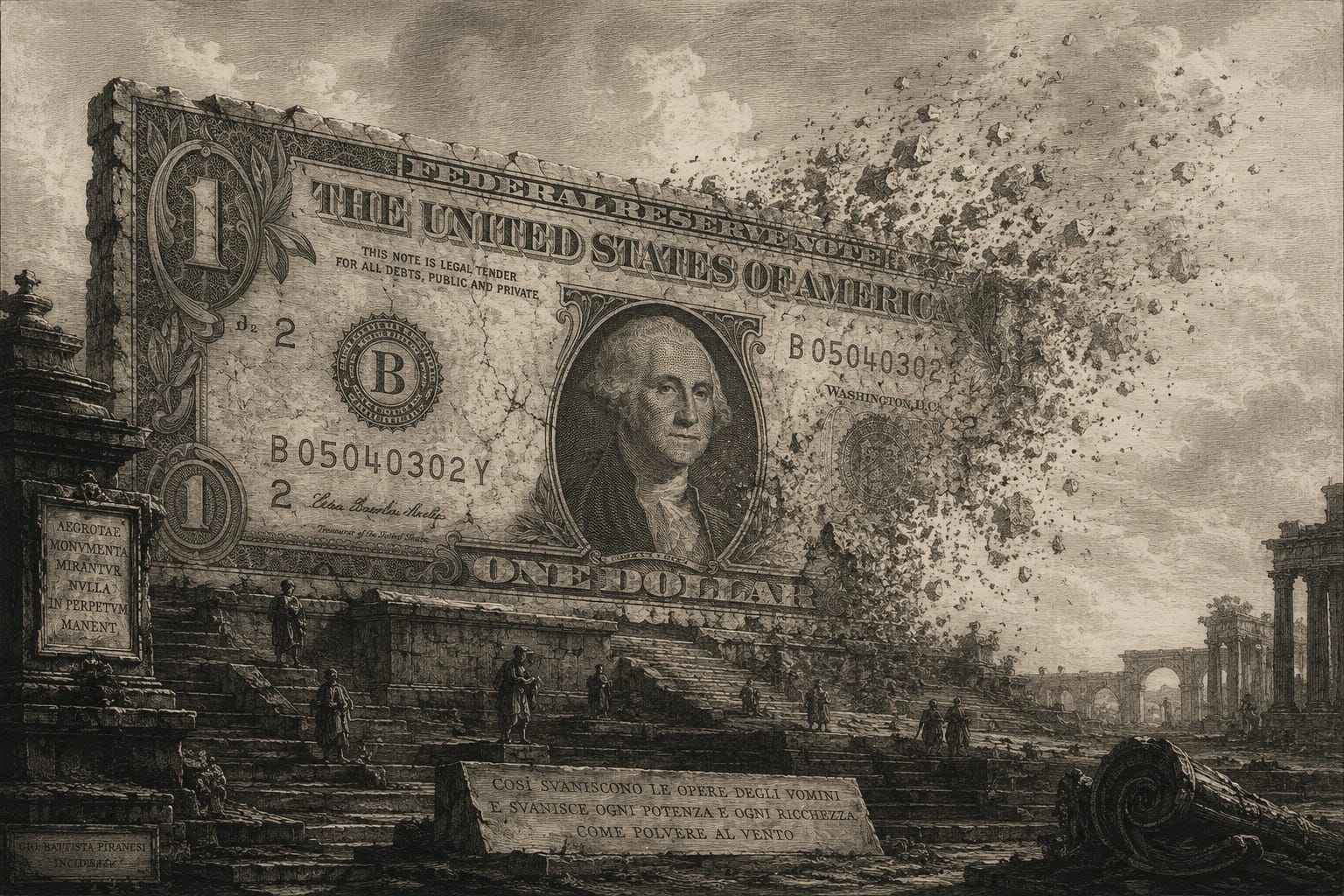
Paul Krugman gives my and Abe Newman’s book, Underground Empire, a shoutout in today’s newsletter. That reminds me that I’ve been meaning to provide an update on what’s happening to US dollar power in the light of recent events.
The short version. The Trump administration seems to be abandoning its long-existing weaponization of the dollar against Iran. It is also enthusiastically embracing cryptocurrencies that were already allowing adversaries like Iran to make and receive payments. But it continues to weaponize dollars against allies such as Europe. This is not resulting in direct pushback, but it is leading Europe to embrace alternative payment architectures that will make it less vulnerable to U.S. pressure in the future. The dollar is not being challenged head-on, but dollar based payment systems are becoming ever less attractive to allies, who worry both about dollar based coercion and the instability and crime risks of dollar-based crypto. That will not undermine the dollar on its own, but might open up possibilities if Other Stuff Begins To Happen.
A decades-long policy direction has been overturned
Last week, I briefly explained how Stuart Levey had radically increased pressure on foreign banks to comply with U.S. sanctions. As Abe and I say in our book, Levey’s main target was Iran. Previously, U.S. banks were already prevented from facilitating direct transactions involving Iran. As we describe it:
Countries that bought Iranian oil needed to pay for it. … Previous U.S. sanctions against Iran specifically allowed Iranian companies to conduct so-called U-turn transactions, transferring their money from one non-U.S. bank to another via the dollar clearing system. This exception acknowledged the central role of the U.S. dollar in global financial transactions, and the U.S. worry that other countries might stop using dollar clearing if it became politicized.
Levey, who was the US Treasury Undersecretary for Terrorism and Financial Intelligence began to reverse that, blocking Bank Saderat from using the U-turn in 2006, and gradually extending the ban so that all Iranian banks were blocked from using the U-turn by 2008. This was a very big part of what prompted Iran to come to the bargaining table on its nuclear program. Financial sanctions made it extraordinarily hard for Iran to get paid for oil. As one former US official described it, Iran was “forced to barter oil directly for ‘wheat and tea from India, rice from Uruguay, and zippers and bricks from China.’”
This is changing. The Department of Treasury has issued a general license, allowing the unblocking of “all transactions prohibited by the above-listed authorities that are ordinarily incident and necessary to the production, sale, delivery, or offloading of crude oil, petrochemical products, or petroleum products of Iranian origin” until August 21. In plain language, if you want to buy or sell Iranian oil using U.S. dollars, you are now welcome to do it. If you want to import Iranian oil into the United States, you now have the blessing of the U.S. Treasury. This goes far beyond reversing the U-turn ban, into normalizing Iranian oil transactions on global markets.
The license is a temporary measure - but it is an extraordinarily important one. It’s notable that the U.S. has not revoked it, even while it and Iran exchange physical attacks. If the license does get revoked, it will send a much stronger signal that the deal is dead than desultory exchanges of fire. If it does not, it signals an extraordinary climb-down by the U.S, and there may be more to come.
The U.S.-Iran memorandum reportedly talks about lifting all U.S. sanctions in the context of a full deal. That would require more than unilateral administration promises - some of the sanctions are written into law. But it is hard to see how the U.S. regains full financial authority, even if the Trump administration decides to do another U-turn on its U-turn on the U-turn. After all, there are now other ways in which Iran can get paid for its oil.
The dollar is being weakened by crypto
Iran has already been able to use cryptocurrency to circumvent the US dollar. A few days ago, the Wall Street Journal published a piece explaining how Iran’s Central Bank has been funneling large sums of money through a complex system of crypto transactions involving the crypto exchange, CoinEx.
Since 2019, wallets with an identifiable link to Iran have moved more than $3.84 billion through CoinEx, according to blockchain intelligence firm TRM Labs. Among its dealings, wallets hosted by the exchange have received hacked crypto acquired by Iran’s Central Bank and transacted directly with accounts that U.S. officials have since attributed to the country’s Revolutionary Guard, that analysis shows. Haipo Yang, a former Tencent engineer who runs one of the world’s largest bitcoin mining pools, launched CoinEx from Hong Kong in 2017. In text messages with The Wall Street Journal, Yang acknowledged that the exchange had been widely used by Iranians, but said it doesn’t have a relationship with the Iranian government.
Iran’s complex system for laundering money also relied on two stablecoins, Tether and DAI, the Binance crypto exchange, and a smart contract on the Ethereum blockchain that swapped Tether for a variety of crypto currencies.
Tether and Binance are prominent members of the rogue’s gallery of crypto: Zeke Faux’s great book, Number Go Up, memorably describes Tether as having a business model that is “practically quilted out of red flags,” while Binance had to pay $4.3 billion in penalties under the Biden Administration, and its CEO was convicted of money laundering and served time. Underground Empire quotes DAI’s founder, Rune Christensen, as arguing that DAO had been designed so that “it could never possibly become a tool of financial surveillance and control,” and explains how the notorious Tornado Cash smart contract was built to facilitate the mixing and obfuscation of crypto currencies.
Past U.S. administrations worried that crypto might undermine the U.S. dollar. The second Trump administration has instead embraced crypto. A few months ago, Dan Davies and I wrote a report for the British Council, describing how even before the Iran debacle, Trump administration policy was weakening the dollar. As we said:
The administration has partly abandoned efforts to extend its enforcement capacities to crypto. An internal memo sent by Deputy Attorney General Todd Blanche … instructed staff at the Department of Justice that it ‘will no longer target virtual currency exchanges, mixing and tumbling services, and offline wallets for the acts of their end users or unwitting violations of regulations’ …. Of course, targeting intermediaries for the acts of their end users is how money launderers are prosecuted; on its face, this appears to give these entities carte blanche.
While the Trump administration has sanctioned particular entities for facilitating Iranian transactions, its unwillingness to take general actions against crypto has encouraged the growth of a system that is resistant to traditional financial controls. Notably, the Trump administration pardoned Binance’s CEO, and Trump appears to view crypto as a handy means to enrich himself, his family, and people close to them.
The U.S. is still willing to use sanctions
Of course, the U.S. is still willing to weaponize the U.S. dollar - just not against Iran. Soon after the Trump administration came to power, a former U.S. sanctions official remarked to me that U.S. financial power was now more likely to be used against allies than adversaries. The U.S. has notoriously pursued financial sanctions against judges and International Criminal Court officials for their impertinence in prosecuting Israeli officials and authorizing investigations of CIA “secret sites” in which detainees were tortured. It also reportedly considered sanctioning the French judge who banned French politician Marine Le Pen from politics for five years for misuse of EU funds. Judges and officials who are sanctioned find themselves cut off from businesses that rely on U.S. financial infrastructure. For example, they can’t get Gmail accounts, use Microsoft Office, or use standard credit cards
European officials have so far been unwilling to push back directly, for fear of escalating the fight. As Lindsay Graham charmingly put it, “So to any ally, Canada, Britain, Germany, France, if you try to help the ICC, we're going to sanction you.” But they have become notably more enthusiastic about building alternative infrastructure that would help to insulate Europe against American financial coercion. This plays into international debates over payment systems, including crypto but not limited to it.
From the Trump administration’s perspective, stablecoins that are linked to the U.S. dollar make illicit transactions much easier, but also extend dollar dominance. From Europe’s perspective, stablecoin’s combination of dollar-domineering, criming and possible financial instability is increasingly unattractive in ways that bleed over into more conventional dollar based payment systems.
The European Union’s “digital euro” initiative recently got a go-ahead from the European Parliament, and is explicitly intended to provide an alternative payment system within Europe that wold push back against dollar-linked stablecoins like Tether. Dan and I quote Philip Lane, the European Central Bank’s chief economist, as explaining how stablecoin:
exposes Europe to risks of economic pressure and coercion and has implications for our strategic autonomy, limiting our ability to control critical aspects of our financial infrastructure. When we rely on international cards, apps or stablecoins, we effectively outsource our payment infrastructure.
As Lane suggests, the EU also increasingly views more traditional US linked payment systems, such as Visa and Mastercard as threats as well. And at least one ECB board member foresees the digital euro being attractive outside Europe:
While the digital euro would primarily be used in the euro area, it is worth considering its possible international use. The current draft legislation foresees an approach that respects the sovereignty of third countries, mitigates potential risks for them and offers them new opportunities. ... Moreover, the digital euro’s design includes multi-currency enabling features similar to those of [the ECB’s existing international interbank payments system]. In practice, this means that non-euro area countries could use the digital euro infrastructure to offer their own digital currencies, thus facilitating transactions across these currencies.
The dollar is not in huge trouble … yet
None of this means that the dollar is in great danger of immediate collapse. As Mark Blyth argues in a recent interview, there is a great deal of ruin in a dominant currency. It is hard for others to move away from dollar payments. It will be even harder for other powers to replace the dollar without radical shifts to their own internal economy. The power of the dollar rests not just on dollar based coercion, but also on its central role in transactions, and the need of countries to maintain dollar reserves.
Still, we are in for some interesting times. During the first Trump administration, Abe and I spoke to former officials who had previously worried that sanctions overreach might destabilize the international role of the dollar. They were revising their opinions, now that other countries had not fled the dollar, and more likely to think that there was little risk of blowback from US financal sanctions. It’s notable that the Biden administration was unable to come up with a coherent policy for limits on financial coercion. In the administration’s “2021 Sanctions Review’ ..., the 40-page draft … dwindled to eight pages and contained the earlier document’s most toothless recommendations.”
Now, in Trump’s second go-around, the coercive power of the dollar is being put to a much more extreme stress test. The result is that US allies are increasingly looking to build alternative payment rails, just as adversaries have done in the past. Almost certainly, this is not enough on its own to precipitate a crisis, but it is likely to leach away at dollar power at its edges, and might combine with other crises and U.S. actions (e.g. would the Trump administration extend unlimited swap lines to other countries in the event of a new financial crisis?) to precipitate a more rapid unraveling.
It's just incredible how Trumpkopf punishes our allies and rewards our adversaries. If I didn't know any better, I would swear he was taking orders from Putin. /s
During the late 1970s, Marc Rich illegally sold Iranian oil that violated the sanctions on Iran. He was found guilty, but evaded jail by decamping to Switzerland. Eventually, his wife got him pardoned by Bill Clinton. Trump is doing a similar thing, but by fiat as a POTUS. Rank hath its privileges! https://en.wikipedia.org/wiki/Marc_Rich