

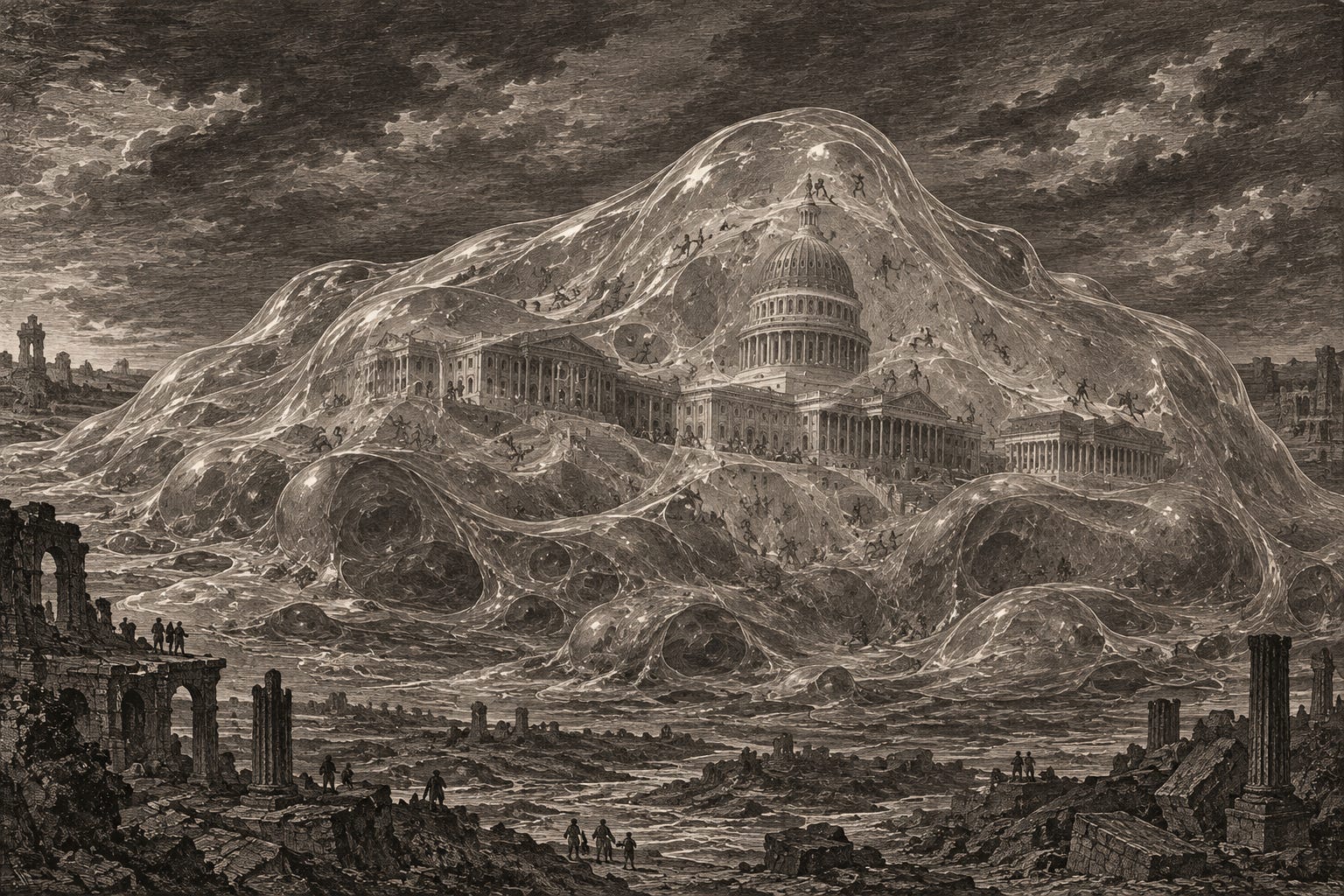
Dan Drezner writes this morning that the foreign policy “Blob,” the reported centrist consensus around the “notion that war and military domination can secure American interests,” does not exist.
there are folks who still believe the Blob moniker has some heuristic punch. … The thing is, I don’t think these folks realize just how much the last decade has scrambled the foreign policy community, thereby rendering the Blob meaningless as a unit of analysis. And any term that obfuscates more than it reveals should be consigned to the dustbin of the marketplace of ideas.
His argument:
Let’s start with the obvious fact that some of the folks who were most eager to attack Iran a decade ago — the neoconservatives — are not exactly in Trump’s corner this time around. … there is the fact that the current administration has been aggressively purging all of the foreign policy and national security professionals that Rhodes would lump into the Blob. … My point, though, is that Trump views most of the folks that comprised the Blob back in 2016 as the enemy at home. … Perhaps the strongest evidence that there is no Blob obsession with bombing Iran is the survey evidence. … in the case of Iran, just 34 percent of executive branch elites favored the unilateral use of force against Iran to halt their nuclear weapons program. With UN Security Council authorization, that jumped to 70 percent.
If only 34% of the Blob was keen to unilaterally attack Iran over its nuclear weapons program then I don’t think one can call it the majority opinion of this set of individuals. Which is what Rhodes, Cambanis, and others are asserting. … outside of FDD and Heritage and a few Hudson Institute folks I am hard-pressed to find any foreign policy professionals who fit the Blob category and endorsed Operation Epic Fury.
… The truth is that the Trump years have torn asunder America’s foreign policy community. There is no common foreign policy consensus. Claims that the Blob still constrains U.S. foreign policy have not aged well.
Dan is a friend. He also has much more direct experience of the US foreign policy establishment than I do. But I believe that in this case he is wrong. There is a “Blob” that plays an important role in shaping foreign policy consensus, but it is not likely to show up in the kinds of survey questions that Dan builds his case on. The truth is that the Blob is an egregore, a class of collective psychic predator that is remarkably difficult to dispel.
******
Jonathan Guyer presents the other side of the case about the Blob in the New York Review of Books a few days ago, beginning with its originator.
Rhodes, who worked under Obama as his foreign policy speechwriter and deputy national security adviser, coined the term “the Blob” in response to the concerted campaign to stymie the Iran nuclear deal. … In that interview Rhodes described the Blob as an assemblage of policymakers who “overstated the capacity of the United States to shape events inside of other countries, particularly in the Middle East.” The term captured not only the establishment’s tendency to speak in a single voice but also the way it seemingly could not be displaced; whatever blows reality delivered to its worldview, it would spring back into its accustomed shape.
The concept of the Blob, as the name might also imply, is slippery and hard to pin down, not quite an ideology or a network or a collection of specific institutions but rather a combination of the three. The term irked many members of the establishment. “It’s a pejorative and imprecise way to dismiss those who disagree with you, and it doesn’t advance the foreign policy conversation,” Richard Haass, then the president of the Council on Foreign Relations, told The New York Times in 2021. Others, like the former CIA director and career ambassador William Burns, have embraced the moniker in their own writing. Some have gone so far as to praise the group it describes. “In truth, the foreign policy establishment is an American strength rather than weakness,” the conservative academics Hal Brands, Peter Feaver, and William Inboden wrote in Foreign Affairs in 2020, in an article titled “In Defense of the Blob.”
… when Trump first waged war on Iran in June 2025, joining Israel in twelve days of hostilities, even Democratic hawks couldn’t entirely condemn the maneuver. As Blinken wrote in The New York Times, “The strike on three of Iran’s nuclear facilities by the United States was unwise and unnecessary. Now that it’s done, I very much hope it succeeded.” … The overthrow of Venezuela’s president, Nicolás Maduro, further invigorated the Blob. … While many from the Democratic establishment criticized Trump’s disregard for international law when news broke of the kidnapping, they also evinced a certain awe. “When we saw this operation unfold and we heard the results of it, I think we all thought, damn, that’s impressive,” Jake Sullivan, Biden’s national security adviser, said on the podcast he cohosts, The Long Game. The Blob, then, decries Trump’s disregard for norms while admiring the results of his lawlessness.
Guyer argues that the Blob is not going away, but changing to adapt to new circumstances.
The foreign policy establishment is also being shaped by its relationship with a new, and newly influential, military tech sector. The Council has invited executives from Peter Thiel’s Palantir to speak about defense innovation and the ever-popular topic of AI, and held sessions with executives from Anduril—the military tech mega-startup founded by the MAGA billionaire Palmer Luckey—and the Trump-aligned venture capital behemoth Andreessen Horowitz. … In a June article for the Financial Times, Hillary Clinton defended the president’s Board of Peace, a multilateral organization with pay-to-play membership requirements that appointed Trump—as an individual, not as the US president—to serve as its chairman, seemingly for life. This is the kind of alliance that Pompeo touted earlier this year at the JPMorganChase Center for Geopolitics. Its director, Derek Chollet, worked as a senior Biden national security official … Formerly a critic of Pompeo’s tenure in the cabinet, Chollet hosted him in February on the center’s podcast to discuss leadership. “We’re going to be just fine,” Pompeo said, “if we can get our senior leaders to sort of figure this all out and stop shouting and start talking.”
What none of this says directly is that there is a very important reason for the sudden renewal of interest in “Blob” discourse. The reason why people are talking about the Blob again is that Democrats look likely to win one or both houses next week, and to have a strong chance of winning the White House in a couple of years. That, in turn leads senators, governors, previously also-rans, and even the odd Congress member to start considering how they might look good behind that podium with the presidential seal. And that, in turn again, opens up the question of who their foreign policy advisors (and hence, people with first dibs on political appointments) might turn out to be.
Usually, one might expect the people who were in the last Democratic administration, with all their experience and connections, to have the clout to get what they want. That may not happen this time around. Joe Biden’s White House presided over what is commonly considered to be a humanitarian and foreign policy disaster - Israel’s razing of Gaza, with many, many thousands of civilian deaths, and with continued US support throughout.
That is leading many people, not just those on the left, to argue that it is time for a new group of people to take charge of American foreign policy. And that in turn is creating an extraordinarily bitter fight within the Democratic party, between those who want the people who got policy horribly wrong (or just passively stood by) to be shoved into the wilderness, and those who, because of beliefs, interests, or some combination thereof, hope that the personnel of the next possible Democratic administration roughly resemble those in the last one.
I have my own preferences in all of this, which can probably be inferred, but are mostly irrelevant (I’m an observer in these debates rather than a participant). The next few weeks after the mid-terms are when we will begin to see the political maneuvering really begin to get going. Blob Discourse is tied up with those fights for obvious reasons. Will the existing elite be damaged, even disgraced? Will it prevail, instead, as it has in the past? We’re likely to see a lot of very angry discussion.
******
My theory of the Blob differs from both Dan’s and Jonathan Guyer’s. Dan sees the Blog as merely fantasy, projected by those who feel themselves to be excluded. Guyer sees the Blob as a perpetually mutating voracious protoplasm, which absorbs new people and new positions as it needs in order to survive. I see it instead as an egregore, a kind of psychic entity that exists less in the real world than in people’s collective understanding. As in Dan’s account, it is less a real entity than a projection, but as in Guyer’s account, it is still very powerful and consequential.
As Guyer notes, it is hard to pin down what the Blob exactly is in material terms. That is because it is not, in fact material. It is a perceived consensus. People in the DC foreign policy establishment, like humans in pretty well every community everywhere, are always trying to figure out what other people are thinking, which groups are moving up and which down, and orienting themselves accordingly. There is compelling empirical evidence that we have specialized mechanisms in our brains for keeping track of coalitional dynamics. To say that the Blob is a by-product of those mechanisms might seem to dismiss it. But oh boy, can it be powerful.
If you, as a foreign policy staffer, think that there is a policy consensus among your colleagues about a particular issue - say, bringing you back to 2002, that we need to go to war in Iraq - then you are going to modulate your own expressed opinions appropriately. You might be a Democrat, who thinks that invading Iraq is a terrible idea. You might also be ambitious and fear that Richard Holbrooke and his crew will squash you ruthlessly for saying this in public, and making the Democrats look weak and anti-war. Whether or not your fears are grounded in the truth is a secondary matter if they are sufficient to keep you, and others like you, from expressing their misgivings.
I have an old academic article with John Quiggin that suggests that economic consensuses are more a product of network structures than actually generally shared beliefs. I also have a more recent post about “malformed publics,” arguing that social media is screwing with our heads in very similar ways (although I only just realized that they are two variants of a nearly identical claim when I started to write this post). Hertel-Fernandez, Mildenberger and Stokes have a paper showing that Congressional staffers have “wildly inaccurate” views of what the public thinks (they believe public opinion to be way to the right of what it in fact is).
But there is a more colorful and less academic way of describing all of this. We can think of the Blob as an “egregore,” a predatory emanation of our collective thoughts that has assumed a force and life of its own. Specifically, we can compare the Blob to the Baileys. “Djinnandtonic” - a pseudonymous poster on Bluesky - posted last year about an imaginary couple called the Baileys, who play a very important role in Senator Charles Schumer’s imagination. According to Schumer’s 2007 book, every time that he considers a political decision, he asks himself what the Baileys, who are middle-class Irish-American Long Islanders, would think he should do. As djinnandtonic describes it, the Baileys are:
psychic entities in the astral plane, thoughtforms of pure malevolence that only Chuck can see. They have haunted him his entire life. When he says “What am I supposed to tell the Baileys?,” he is afraid. Their True Name is unutterable.
This aptly describes the Blob - which is of course a much more Lovecraftian sounding class of a psychic emanation than any Irish-American couple. In one sense, the Blob does not exist. You cannot point to an institution, a central organizing committee or any other visible apparatus. It may be absolutely true, as Dan says, that foreign policy elites are individually much less committed to war against Iran without Security Council clearance than the notion of the Blob might lead you to surmise. But in another, equally important sense, the Blob most certainly does exist, so long as everyone believes that it exists.
If you think that your career will be hurt if you go against the Blob, then you will very possibly decide to do nothing. You will orient your professional expectations around the existence of the Blob. You may even participate in the punishment of others because you think that this is the expected thing that you are supposed to do. And you might turn out to be completely wrong about what everyone else believes. I would be really interested to see a version of Dan’s survey which asked people not what their own views were about going to war with Iran, but what they believed others’ views were. I suspect, maybe incorrectly, that the answers would have been very different.
From this perspective, the Blob is a similar class of an entity to the Median Voter (has anyone ever met one of these mythical political entities?), the Vibes, and other such manifestations. Their power is not in their physical existence, but in the fact that people believe that they exist, and that they represent some collective judgment that they need to adjust their behavior towards. Furthermore, those who can say with confidence that they have the Blob (or the Median Voter, or the Vibes) on their side, and not be contradicted, usually have more power than those who do not.
Dan suggested, when I laid out an initial version of the thesis, that the Blob exists only in the minds of those convinced that they are not “part of the in group.” I don’t think that is right. I’ve been at a meeting in a big DC think tank which began with the senior fellow who was organizing welcoming us all to the “heart of the Blob.” He didn’t seem to be joking, so much as expressing his enormous satisfaction that there was an establishment consensus, and he reflected (or perhaps even helped guide) it. Equally, I suspect that most people (not all) would angrily disclaim their membership of the Blob if pressed in public, in terms similar to Richard Haass. Outside certain private contexts, it does not seem to be a very nice thing to be part of.
So I disagree with Dan. The Blob exists and is important, even if one can’t readily put one’s finger on it. Equally, it’s under pressure. Despite Guyer’s arguments, the Trump Republican party’s relationship with the hawkish elements of the foreign policy elite are at best equivocal; that might of course change if e.g. Marco Rubio takes over after Trump departs the scene. If that doesn’t happen, and the rebels in the Democratic party also prevail, forcing a significant portion of the party’s foreign policy elite into the wilderness, then I think that it will be fair to say that the Blob is dead. No-one will believe in it any more.
Neither of those outcomes is inevitable, and both depend on who wins in upcoming fights. You should expect a lot of bitter factionalism, and a lot more Blob Discourse, for and against, over the coming months.
Great stuff. Would love to see that additional survey. But was surprised not to see a link/parallel with lindblom and structural power of business
I'm not a foreign policy guy, so take all this with that in mind. Maybe my view of matters is simply incorrect. But I'm a bit confused how this disagreement with Drezner would cash out in slightly more specific terms. For instance: Drezner quotes a tweet of his saying that "There's stuff you can pin on the Blog but the Iran war damn sure ain't one of them", to which Ben Rhodes (the onlie begetter of the blob) replied "I literally coined the term 'The Blob' to describe people who wanted to go to war with Iran." I assume (possibly incorrectly) Drezner's argument was that this latest war was a brain fart of Trump's and thus couldn't be blamed on the policy establishment. (Personally this seems persuasive.) I honestly don't understand Rhodes's point of view (does he think that members of the Blob talked Trump into it?). And what would you say? That Trump's own perception of the consensus made him think it was a good idea? That seems to ascribe far more rationality to Trump than seems warranted.
Or to come at this from a different angle: Drezner argues (and it jibes with what I read in the papers) that Trump has fired the experts and promoted incompetents in foreign policy, as he has everywhere else. This strikes me as a good argument for Drezner's view: if the Blog is individuals & institutions (as Rhodes has it), then presumably those ins are not really that influential? (Unless you want to say that Netanyahu was the key factor, and they influenced *him*, I suppose.) But how would you argue it? If it's true that Trump has fired the experts and promoted incompetents in foreign policy as he has everywhere else, what is the role that the perceptions of consensus playing? Do you think that that perception is really influential among these new clowns who were promoted for their loyalty and not being part of the group who had independent reputations (and thus might. challenge Trump)? Seems unlikely. And then you need to factor in that Trump's appointees themselves may have less influence than the emotional resonance of whatever AI slop Natalie Harp has served Trump for breakfast that day. How do you, under your reading of the Blob, parse all this?