

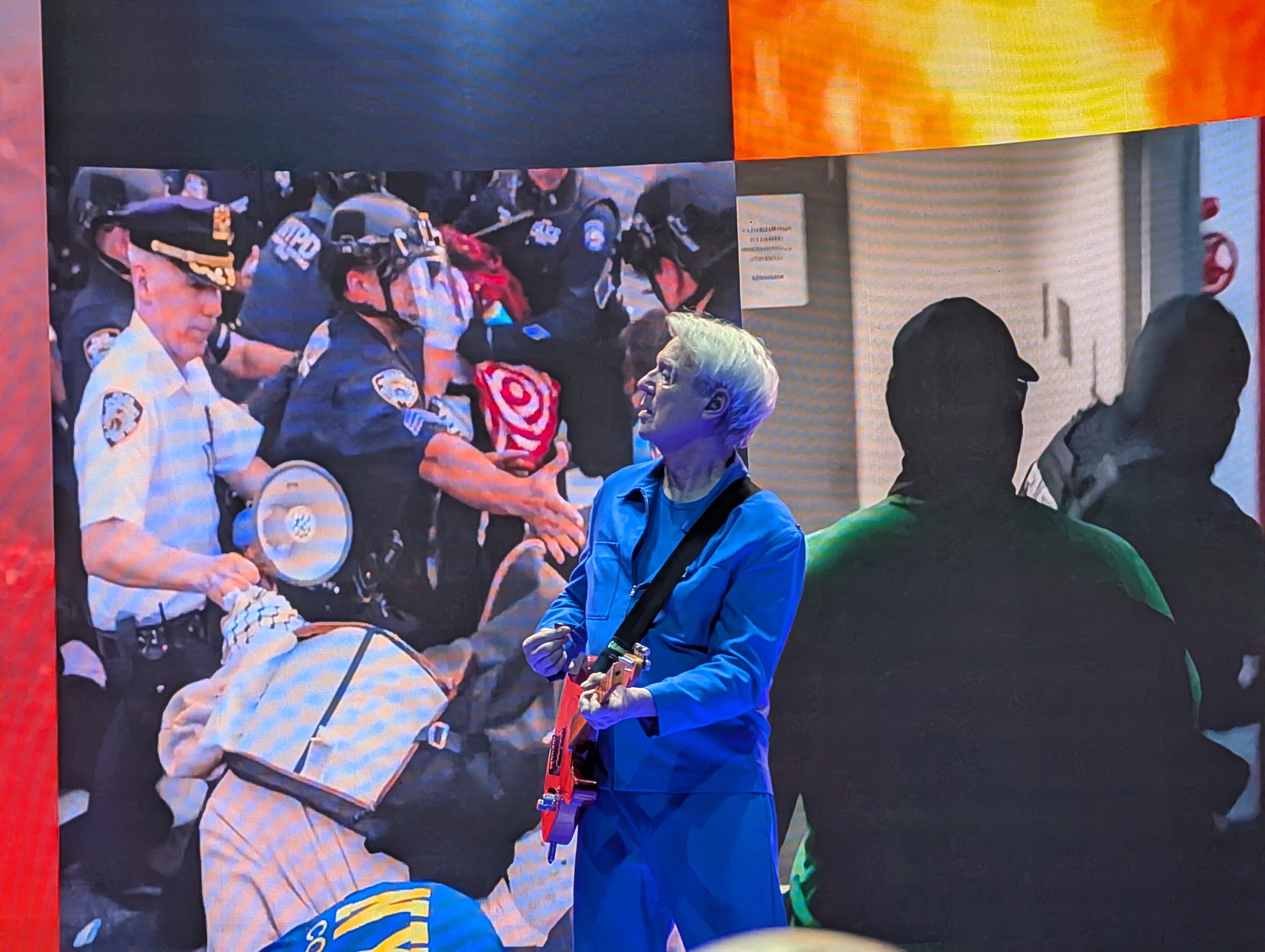
[David Byrne playing “Life During Wartime” live, Washington DC, September 28, 2025. Author’s photo]
I did the Ezra Klein show last Friday, and it went up on the NYT website this morning. A whole lot has happened in the meantime. The way I think is through talking with other people, and a lot of thinking happened in the conversation. It wove together what happened in the world last week with what is happening in Minneapolis, in ways that I am still trying to work out. So here is a short interim report, written less as a polished essay than an attempt to pull these thoughts together.
What became clearer to me, as Ezra and I talked, is the connection between the limits to US power in the world, and the limits to the Trump administration’s power inside the borders of America. We briefly mentioned a long-ago fight that I had with the late David Graeber, who advanced a theory of world politics in his book, Debt, that described the global economy as a tribute system, and emphasized the awesome power of the United States to terrify the rest of the world into submission. Back then, I disagreed with Graeber’s claims and Graeber took strong exception to my disagreement, provoking a very long response from me. The upshot of my argument was that the United States is incapable of pulling what I called the “Delian League Switcheroo.” Thucydides describes how 5th century BCE Athens transformed its alliance against the Persians, the Delian League, into a protection racket to squeeze allies and turn them into vassals. I argued back then that the US would find it very hard to do this at scale:
The US ability to intervene abroad is limited both by financial costs, and by difficulties in maintaining domestic political support. This suggests that the US power to intervene militarily abroad is far more qualified than Graeber thinks it is. The current world order can very reasonably be described as an empire. But it is not an empire of crude coercion where the US can call all the shots, based on its military capacity, or where other countries can expect military intervention if they e.g. stop denominating important stuff in dollars, or fail to pay their debts.
In fairness to Graeber, the Trump administration’s consistent policy over the last year appears to be to make his nightmare vision come true. The administration clearly does want to turn allies into vassals. But as we saw last week, it doesn’t have the power to do this. When it wants to intervene in one part of the world, it has to forego opportunities to intervene in others.
Ezra and I also discussed Thucydides’ Melian Dialogue - ‘the strong do what they will, while the weak suffer what they must’ - which Mark Carney quoted at the beginning of his speech. Trump-sycophants, catchfarts and sneaking regarders like Niall Ferguson like to cite this speech as evidence of the eternal verities of international power politics. But as Seva Gunitsky says here, Thucydides used it instead to illustrate Athenian folly. Athens’ hubris was clobbered by nemesis, when its expedition to Sicily failed, resulting in the destruction of hundreds of ships and the slaughter or enslavement of thousands of hoplites.
Domestic politics too was corrupted across the entire Greek city state system, as everyone took sides in a struggle between soi-disant democrats and soi-disant fans of oligarchy that fused warfare between city states with domestic factionalism :
Words had to change their ordinary meaning and to take that which was now given them. Reckless audacity came to be considered the courage of a loyal supporter; prudent hesitation, specious cowardice; moderation was held to be a cloak for unmanliness; ability to see all sides of a question incapacity to act on any. Frantic violence became the attribute of manliness; cautious plotting a justifiable means of self-defense. The advocate of extreme measures was always trustworthy; his opponent a man to be suspected. … even blood became a weaker tie than party, from the superior readiness of those united by the latter to dare everything without reserve; for such associations sought not the blessings derivable from established institutions but were formed by ambition to overthrow them; and the confidence of their members in each other rested less on any religious sanction than upon complicity in crime.
From Athens to America: does any of that sound at all familiar? Mothers and nurses become “domestic terrorists” when they are gunned down in the street. Hesitation to crush the “organized illegal insurgency” is a sign of weakness. Hatred of moderation, exaggerated manliness, extreme measures, destruction of institutions. I could keep going on, and on, and on, but I suspect that most readers know it already. The parallels are clear enough.
The Trump administration’s domestic hubris seems to be running aground, after the killing of Alex Pretti (which happened after the show was recorded). I don’t believe that the Trump administration is going to back down any more than it absolutely has to. Still, the limits to its power to escalate are becoming clearer. When confronted with large scale peaceful resistance, the administration finds that it is not nearly strong enough to overwhelm. The weak do not need to suffer so long as there are enough of them and they can get organized.
To summarize the joint claim of this week’s and last week’s posts, the Trump administration faces the same problems with its opponents at home as its soi-disant allies abroad. Its advantage is that it is much more powerful than any of them individually. Its disadvantage is that it is much too weak to crush them all at once. The administration’s powers of intervention are limited. When it tries to bully Europe into giving up Greenland, it discovers that it has to back down when it faces united opposition. ICE and CBP are perfectly capable of disrupting the life of a mid-sized American city. They are not capable of controlling it if the population pushes back.
That does not mean that the victory of the allies, or of protesters in Minnesota and around the country is assured. Collective action - whether among countries or people - is always hard, given differences of interest and belief. There is a lot that the administration can do, and will try to do, to pick off defectors. And both at home and abroad, there is a vacuum of leadership. If counteraction does not become institutionalized, it eventually becomes exhausted. Even so, there are possibilities to work with.
Finally, as Ezra emphasized in the conversation, visible moral degradation is a turn off for many people. I responded by drawing on the political science:
Susanne Lohmann, a political scientist, wrote this classic article on this. She argues that the Leipzig protesters seemed like normal people — good, decent people you would like to have as neighbors. The East German propaganda is that these are evil, weird freaks, that these are dissidents, they’re scruffy, they’re whatever. And it’s the fact that these look like normal, ordinary people that actually make this powerful.
So I think what we’re seeing in Minnesota is we’re seeing ordinary people. It’s very clear that the people who are organizing, the people who are pushing back are neighbors. They are people who seem like very straightforward, very ordinary Midwestern people, people who are part of the community. I think that the killing of Renee Good … She is not a domestic terrorist under any reasonable definition … this becomes more and more of a weakness.
Bringing the political science is in part a personal protection mechanism: I find it very hard to be impassive or coolly analytical about what is happening, and talking about the scholarship rather than the beatings and killings helps me get through. But there is an analytic point nonetheless, which has been made even more clearly by the events of the last few days. Cruelty can sometimes turn out to be a weakness rather than a strength.
Corrected to fix a naming error and two errors about Greek history. Thanks to Brad DeLong and Neville Morley for spotting and pointing out.
("Alex" Pretti, not "Joe")
Thanks for raising the point about collective action in the Ezra talk and now.
Focal points help overcome these problems, as you know. Carney invoking Havel at Davos was a clear attempt to create a focal point. It was highly successful, esp internationally, and Carney is perfectly-situated for this role, he's been planning this moment since before he even got into the race.
Now Goode and Pretti have created another focal point, domestically. The two reinforce each other: Italian politicians protest ICE at the Olympics, Trump skips the Super Bowl so as not to be booed and heckled in front of the entire world: focal points.
This is a moment to pull on every lever. No pausing to regroup, no waiting to see responses, step into the space they are currently vacating and then push even harder from there. Today we demand Noem, Miller, and Bondi all go. If that doesn't happen then starting making deals with congressional Republicans: what do they need to swing the Speakership to a Democrat?
The alpha and omega of Trump's approach to governance is control of the media narrative, with himself at the center. Noem has gone all-in on generating content meant to make herself and Trump look "strong" but each cabinet member is on that page, except Vought. Being unable to mount a Minneapolis-sized presence in more than a few cities isn't seen as a weakness since the goal is a steady stream of controlled content, not subjugation. Plus meeting Miller's insane deportation quota numbers.
Trump's TACO on Greenland was a stalemate, not a failure, because Trump lost nothing (in his mind) while making himself the center of attention and speculation in media coverage. There will be other chances to make a Deal with Denmark. They can't exercise the power they brag about in fact, but they ultimately don't care about that. Trump and his party have bet that controlling the virtual power of media perception is how they control the public and the world, backed by the systems the US has built over the last 80 years to exercise de facto control. Pure short-term thinking.