

Over the last few months, Cosma and I have been writing a new paper, “AI as Social Technology.” It’s now out, in the Knight First Amendment Institute’s series. I’m obviously terribly biased, but I think it’s a banger. Go read it.
The piece has three main aims. First together with other things we have written, it pushes back against a generic strain of Singularity thinking, which deploys feral thought experiments to prophesy the near future. Instead, it argues that you ought draw on actual social science and history. They will tell you that things are more complicated and interesting than stylized accounts would have you believe, but that is because the future is likely to be a mess, in ways that both resemble and are dissimilar to the mess we have today.
Second, it aims to provide sa better way of thinking about the mess. In particular, it combines recent work on “coarse graining” with the ideas of Herbert Simon and Charles Lindblom, suggesting that these build common ground between computer science, the traditional social sciences and science and technology studies.
Finally, and most directly, it argues that one particular variety of dubious AI thinking helped fueled the rise of DOGE.
AGI-centric accounts depict bureaucracy as centralized coordination, the key problem being how lower layers fail to implement the priorities of the top … Speculative arguments about AGI helped inspire Elon Musk’s DOGE project, which sought to hack away great swathes of America’s administrative machinery. Much of DOGE’s work and aspirations involved the application of LLMs and AI ‘agents’ to accomplish a variety of open-ended tasks, often very badly. … We certainly can’t blame AGI speculation alone for DOGEmaxing and the Trump administration’s evisceration of the federal bureaucracy; there are many overlapping causes. However, if you believe that the duty of a bureaucracy is to implement the leader’s program, and AGI is nigh, it is not hard to conclude that the latter offers a providential way to accomplish the former.
There’s lots more in the paper, including plenty more detail on the intersection between AGI-speculation and DOGE thought, and argument how the consequences of AI for bureaucracy are going to be much messier than any of these stylized interpretations. But there are also things that we didn’t have time to talk about. Two are worth mentioning.
First, “effective accelerationism” is an important part of the intellectual mix that helped produce the AI-DOGE chimera. In particular, the neo-reactionary arguments of Nick Land have had real, and pernicious consequences. “DOGEMaxing” and similar notions owe an intellectual debt to Land’s ideas (the term “machinic” pops up a lot in argument), even if the people who make these arguments don’t necessarily agree with everything he says. Claims about how our world will be radically remade in the image of machine logic are nearly ubiquitous, whether the authors view the machine-god state as something to be feared, celebrated or both at once. Equally, as as we suggest in the quoted excerpt above, AI speculation is only one justification for the Trump administration’s efforts to disembowel the administrative state. I’d be startled to discover that e.g. Russell Vought has been reading technology-fueled neo-reactionary online manifestoes.
Second - and this is something I figured out belatedly when writing, is that there is a fundamental difference between the disastrous DOGE project and the apparently similar push by both center-right and left leaning people to create a more effective and responsive government bureaucracy. That has in fact been the source of considerable confusion. The two approaches differ crucially on the question of who should the government be responsive to?
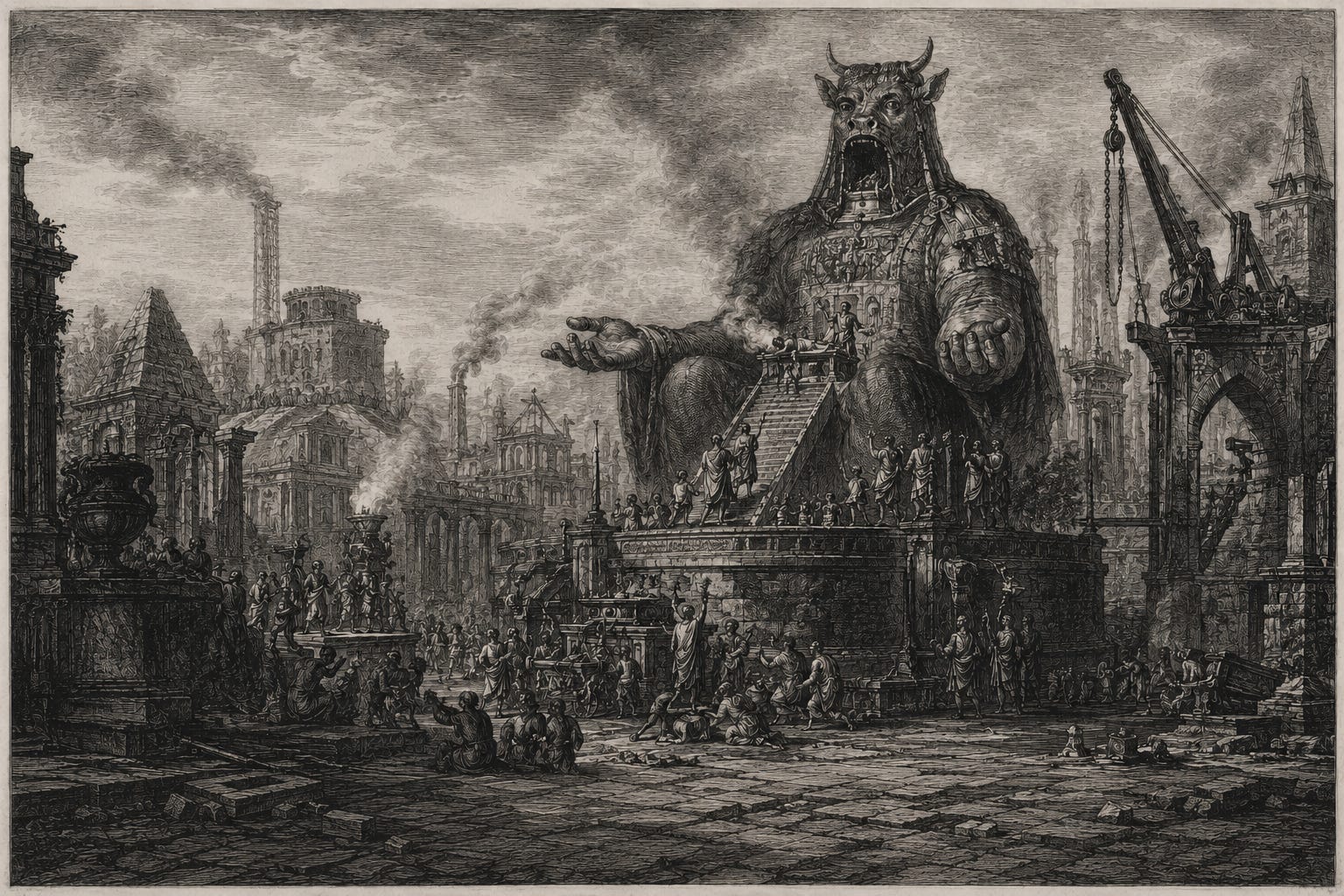
DOGE/AI Thought starts from the premise that bureaucracy should be primarily (perhaps even exclusively) responsive to the people at the top. From this perspective, the problem that AI solves is a mixture of regular institutional inertia and specific “deep state” resistance. There are implied tradeoffs for some people who buy into this argument (others; the true idolators, may simply not care that much). Using AI to build the machinic Moloch means both empowering the Trump administration in its quest to build up American Greatness, and empowering the Chinese Communist Party in its quest to stamp out human individuality and freedom. What makes it easier for Trump to get rid of mid-level official saboteurs by buying in private sector AI and expertise, also makes it easier for Chinese Communist Party leaders to construct machine learning apparatchiks that perfectly implement its program. Under this analysis, perhaps you can hold China back by e.g. not exporting the fastest chips for AI training; perhaps not.
The effective government bureaucracy people, in contrast, are not in the business of making sure that Dear Leader’s commands get implemented as they ought. Instead, they are primarily interested in freeing bureaucrats to do things that are obviously the right things to do, rather than burying them beneath the concrete of top down mandates. The impulse, then, is to trust bureaucrats more, and give them the means and autonomy to respond to obvious needs. This involves creating better feedback loops between top and bottom, so that measures, tools and perhaps even goals are redefined as the problem becomes better understood. But it also means creating interfaces through which bureaucrats can engage more with the public, and respond better and more quickly to public demands, as well as helping them work sideways with others in the bureaucracy who have necessary skills and knowledge, without getting smothered in red tape. The general bet is not on better subjugating bureaucrats, but on making them more autonomous. This is more or less the opposite of DOGE, and its vision of AI is murkier.
Obviously, some reforms or technologies that might help the one vision might plausibly help the other. But one of the implications of Cosma’s and my arguments is that they have radically different understandings of what the state should be doing, and for whose purposes. I suspect - though this would require a lot more work to establish - that the differences between DOGEMaxing and the effective bureaucracy approach map quite well onto the differences between Soviet cybernetics with its programmatic ambitions to Plan Everything, and the management cybernetics of Stafford Beer and his colleagues. Like those, they are very different approaches that are lumped together because of some commonalities of terminology.
Anyway - these are side notes to a larger argument. If you are interested, do read the piece itself!
"...bureaucracy should be primarily (perhaps even exclusively) responsive to the people at the top." THIS is the 'unitary executive' notion that both the Epstein class and the Koch class have been hammering into the 'discussion' for around fifty years. And they worked and worked and connived and manipulated until finally they'd fertilized a suitable 'unitary executive' sufficiently that, like an invasive species, he choked off all the more organic and diverse growth. They golf-carted him into the office, and in return for getting his hands on the checkbook, he's given them the keys to the store and a chainsaw. The pirates are owning the coasts and harbors now, and the bandits the plains and forests. Such as that remain. The coast guard and the sheriff's posses have been disarmed and disabled.
A bit of prose that rings ever more true for me. A cranky Welsh Anglican cleric, a hundred years ago:
"The Machine appeared in the distance, singing to itself of money. Its songs were the webs they were caught in, men and women together. The villages were as flies to be sucked empty. God shed a tear. "Enough! Enough!" he cried. But the Machine just looked at him, and went on singing." R. S. Thomas. from "other"
I look forward to a careful reading of "AI as Social Technology".
Oh, and I recommend the acerbicly cynical critic Ed Zitron for his ability to read the techbro's financials and pluck the legs off this developing fraud. Here: https://www.youtube.com/watch?v=or8butOTUp8
Thanks for your work. It's important.
Tim Long, Just Up the Hill from Lock 15
For me, at least, this was helpful beyond words. Thank you.
Goes to show: agreeing on the objective but not the justification for the objective means you don't actually agree on the objective.