

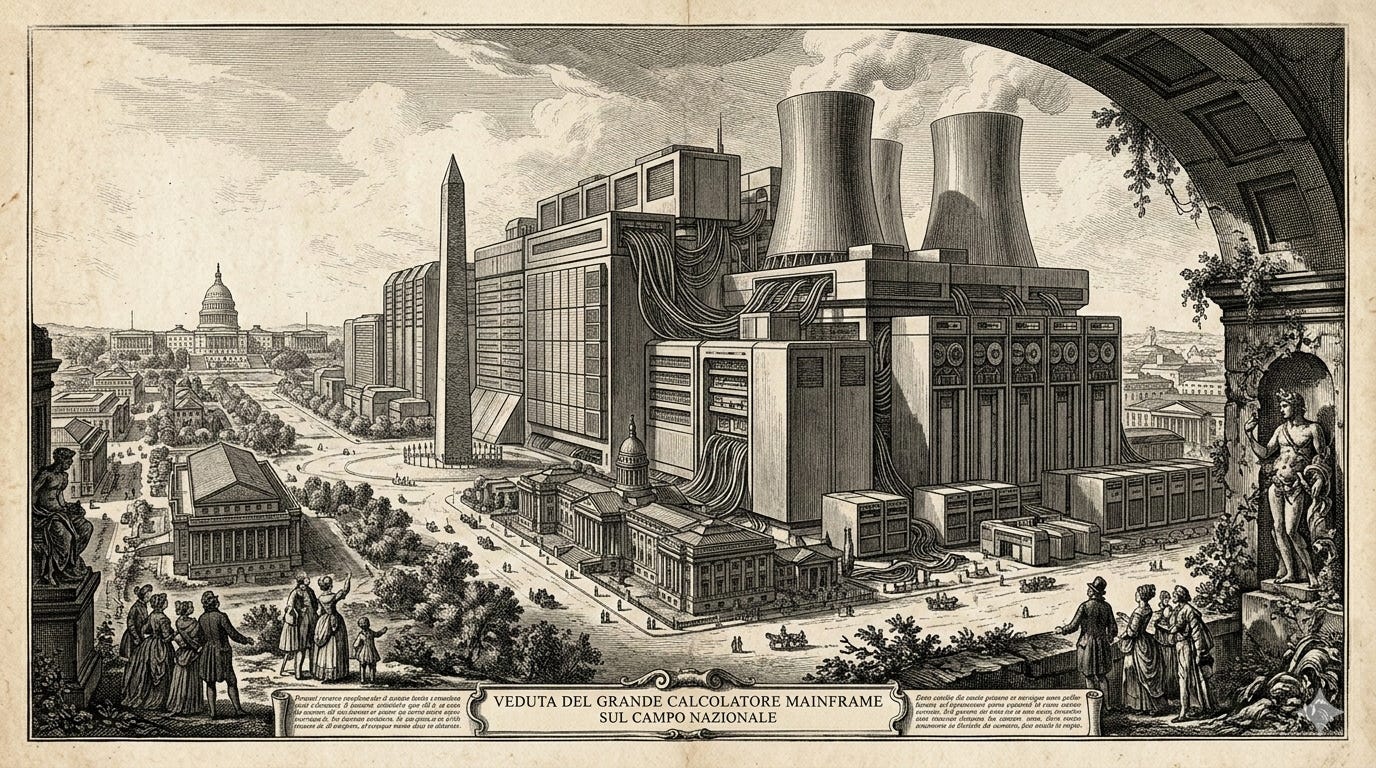
There’s lots that can and will be said about the battle between the Department of Defense and Anthropic. For those who haven’t been following, Anthropic says it won’t allow its models to be used for fully autonomous weapons or for mass domestic surveillance in the US.* The US Department of Defense (which currently identifies as a “Department of War”) insists that it will only contract with AI companies that allow “any lawful use” of their technologies, without reservations such as those that Anthropic has made. It has furthermore threatened that it will designate Anthropic as a “supply chain risk” and invoke the Defense Production Act to force Anthropic to create models without any safeguards for the US military.
It won’t surprise any of my readers that I don’t think that models should direct murderbots or power up the Panopticon. But I think that we also should pay attention to another, less immediate aspect of what is happening.
One theory of the current era is that the interests of the Trump administration and a particular subsection of the Silicon Valley elite are fused so closely that the one cannot be distinguished from the other. Both sides after all are more interested in plunder than in liberal democracy. Another is that there are tensions - perhaps irreconcilable tensions - between them.
Obviously, Anthropic is not part of the pro-Trump Silicon Valley plunder squad. Still, if the Trump administration actually uses the Defense Production Act or similar measures against Anthropic, it’s going to mark a big shift in the political economy of state-private actor relations in the US which might endanger the looters more than they think. If Elon Musk or Alex Karp are at all capable of sober reflection,** they might realize that this change is likely not in their interests, regardless of whether the Trump administration loses or wins the next presidential election.
To understand this, you need to weave four skeins of thought together. First, that of Marion Fourcade and various of her co-authors, who have documented how private sector entities now dominate data gathering and supply, so that the state has become increasingly dependent on them. Second, that of Alondra Nelson, who explains how the Trump approach to AI is better understood as regulation based on arbitrary rule than deregulation. Third, Nikhil Kalyanpur, on how dangerous full oligarchy can be for oligarchs. And fourth, my own sort-of-addendum, which concerns what Democrats might do should they return to power.
Some side-notes: I know Marion, Alondra and Nik and will refer to them by their first names from here on in, since I would feel weird not so doing. Second - I thought through some of these issues together with the students in my class on AI and Democracy yesterday, since our week on AI regulation coincided with the sudden onset of the crazy. They deserve full credit should any of this be interesting or useful, and no blame if it is not.
********
Marion’s ideas about data, the state and the private sector are expressed in half a dozen articles with various co-authors, and pulled together most succinctly in work that has yet to be published. So I’m not linking, but instead providing a likely imperfect summary of her and her co-authors’ contribution. For current purposes, the key thing to understand is that the game between the state and the private sector has changed. Once - and not too long ago, the state had much more and much higher quality data than private sector actors, and was much better capable of using it. Think e.g. about the work that the U.S. Census Bureau does, collecting data in tidy and well ordered (albeit sometimes problematic) categories and making it available. Now, the tables have turned. We live in a world where much much more, albeit much messier data is available, and the best tools for managing it and making it useful belong to the private sector rather than government statisticians.
This is one important aspect of a broader process of state transformation. The US government - like other governments - has increasingly contracted out many tasks that used to be core parts of state functioning to the private sector. This may or may not create greater efficiencies, depending (accounts vary). Undeniably, it hollows out state capacity and the capacity of the state to function independent of contractors. Governments find themselves increasingly incapable of carrying out even very basic functions without the help of private sector actors.
As government becomes more dependent, private sector actors become more powerful, whether or not they choose to exercise that power. Sometimes, the government may be able to shift responsibilities to actors it thinks more trustworthy: the Trump administration has done everything it can to shift certain government data functions towards Palantir, and away from Booz Allen, Accenture and other, more traditional contractors. Sometimes, it is nearly impossible to get rid of a contractor; their knowledge is so particular, and their systems so deeply integrated that they become effectively irreplaceable.
This is the dirty secret of the Trump administration push to both privatize government functions and increase executive authority at the same time. Extensive privatization of government functions and unitary executive theory are really hard to reconcile with each other, no matter how hard regime apologists try to claim that they go hand-in-hand. The more that the government relies on outside actors to carry out its core function, the more vulnerable it becomes to those private actors’ wants and desires, which may differ sharply from those of the administration itself.
That is likely a big part of the Trump administration’s discomfort with Anthropic. The push to discipline Anthropic comes from the need to reconcile its desire for top-down authority with its reliance on AI companies to carry through the large scale transformations that it wants to carry through. To reshape the public sector in its image, the Trump administration needs reliable private actors. But trying to discipline those actors may create its own difficulties
********
Unfortunately for the Trump administration, its proposal to ruthlessly crush Anthropic’s opposition carries its own problems. The immediate problems are legal: can the Trump administration actually deliver on its threats? Declaring Anthropic to be a supply chain risk would be a remarkably bold move: this is an instrument that was developed to target non-US (read: Chinese for the most part) firms that are directly loyal to another government. Courts might very plausibly take a skeptical view. The government is on somewhat firmer legal ground with the Defense Production Act, which allows the government to carry out very sweeping measures to press firms into service to provide products that the government wants, although Alan Rozenshtein at Lawfare suggests that the law could be interpreted in different ways, depending on what exactly the government wanted to do.
I want to ask a different question. What happens if the Trump administration can get away with this in the short term (courts move slowly, and are not good at dealing with facts on the ground) and perhaps in the long run too?
Here, it is useful to turn to Alondra’s analysis. She argues that it is a mistake to think of the Trump administration’s approach to AI policy as a kind of deregulation. Instead, she says, it is a kind of “hyper-regulation” that involves a “systematic preference for executive discretion over deliberative process.” In part this is done via “regulation through ownership;” acquiring stakes in businesses that provide a means for direct influence with little Congressional oversight. In part, this involves other forms of arbitrary caprice.
The Anthropic battle makes visible another kind of hyper-regulation: threatening enormous and potentially existential consequences for companies that don’t fully submit to the Trump administration’s demands. These threats are being made now because (a) Anthropic is visibly disaffected from the Trump administration’s political agenda, and (b) runs aspects of state functioning that are increasingly essential.
So one interesting question for the future is whether companies that fulfil condition (b) but not (a); that is, companies that are currently on board with the Trump administration’s ideology, but are essential to state functioning, ought worry? Should Alex Karp (Palantir) and Elon Musk (X/Space-X etc) be sweating? I think that the answer is yes: they absolutely should.
********
This is where Nik’s arguments come in. He suggests that Trump-friendly billionaires in America are making a “Faustian bargain” that is likely to bite them where it hurts. American oligarchy may not be a sustainable political equilibrium. As countries become more authoritarian, the options for billionaires become ever more tenuous and exigent. They find themselves increasingly subject to “billionaire discipline” and dependent on the whims of the state.
In essence, oligarchs risk vanishing—keeping your private income streams will turn you into a tycoon. Like Jack Ma, individuals that choose that path will live in fear of expropriation, intimidation, or regulatory suffocation. Or they could give up their independence, trying to turn themselves into kleptocrats, as we have seen Musk begin to do by relying more on government contracts for his income.
Even kleptocracy has its dangers. Kleptocrats who lose the regime’s favor are likely to find themselves expropriated, if they are lucky. If they are unlucky they may discover that plane accidents happen, people fall out of windows, and food poisoning can be rather more unpleasant than an uncomfortable 24 hours.
Obviously, American billionaires are still well insulated from the worst aspects of authoritarianism. But the enthusiasm of the Trump administration to threaten Anthropic with quasi-expropriation for not embracing its program 100%, suggests that they are not nearly as safe as they might like to be, and that this is especially true of billionaires like Musk and Karp, who run systems that connect to the vitals of government. Even the weird mixture of wannabe-dictatorship and democratic opposition that we are in presents them with real dangers. If Musk falls out with Trump again, what will happen to him? Just to the extent that he is increasingly reliant on government relationships, his business is increasingly at risk. It is not at all clear that it would survive.
The key point that Nik makes, as I read him, is that authoritarianism is not nearly as sweet a deal for well connected billionaires as they might like it to be. They swap the vagaries of democratic politics (the public may not like them) for the vagaries of court politics (people go in and out of favor all the time). And, as per Alondra, the latter is far less predictable than the former has been in the past. Billionaires could act against Biden without having to worry that they would be destroyed. They have much more serious worries about Trump, and the more that US democracy veers towards autocracy, the greater their worries should be. Russian oligarchs thought it was a great idea to help usher Putin into power. And indeed, some of them were right, sort of, so long as they were willing to knuckle when they were told to knuckle. For others, it turned out to be a rather unfortunate error.
There is a very obvious corollary to all of this. What if the Defense Production Act is invoked, but Trump and his cronies are weakened later this year, and kicked out of office in 2028? What possibilities might the Act offer, say, to President AOC?
Any post Trump administration is going to face the problem of disentangling the government and the political economy of the United States from the sleaze, corruption, self-dealing and autocratic measures that are piling up. Sweeping authorities to reshape the relationship between the state and private sector could make some aspects of that task much easier.
I think a lot about this conversation between Colin Kahl, then Biden’s Deputy Secretary for Defense, and Elon Musk, about Starlink access during the Ukraine war
The Pentagon would need to reach a contractual arrangement with SpaceX so that, at the very least, Musk “couldn’t wake up one morning and just decide, like, he didn’t want to do this anymore.” Kahl added, “It was kind of a way for us to lock in services across Ukraine. It could at least prevent Musk from turning off the switch altogether.”
Typically, such a negotiation would be handled by the Pentagon’s acquisitions department. But Musk had become more than just a vender like Boeing, Lockheed, or other defense-industry behemoths. On the phone with Musk from Paris, Kahl was deferential. According to unclassified talking points for the call, he thanked Musk for his efforts in Ukraine, acknowledged the steep costs he’d incurred, and pleaded for even a few weeks to devise a contract. “If you cut this off, it doesn’t end the war,” Kahl recalled telling Musk.
What would that conversation have looked like if the Defense Production Act had recently been deployed by a different administration to force a major tech provider to supply what the government wanted it to supply? What would negotiations between a Palantir that has become deeply embedded in the US government’s core systems and a putative Democratic administration in 2029 look like if the administration could just dictate terms? Perhaps Musk, Karp and their underlings have not thought through the implications, but they could be far-reaching.
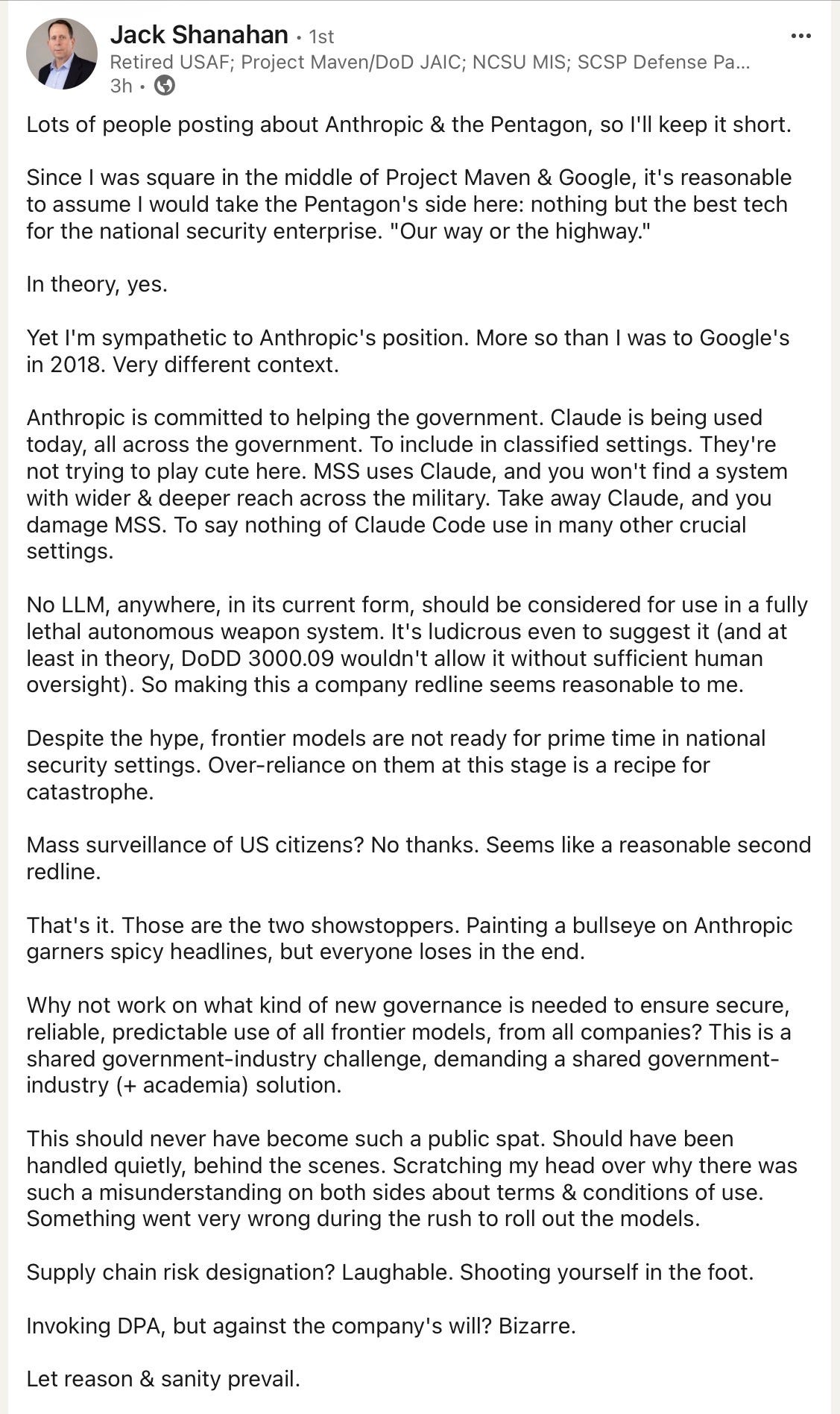
To be absolutely clear: I do not want to imply that it would be a good thing to see the Defense Production Act invoked against Anthropic. I am deliberately focusing on just one set of relationships and possible implications under different scenarios, because I think they’re being overlooked in the debate right now. Even if you are in favor of empowering President AOC a few years down the line, you might want to think about the more immediate consequences. Nor do you need to believe in the case for strong or weak AGI to worry about how the Department of Defense might use these technologies. As Jack Shanahan suggests, you ought be more worried rather than less if you think these technologies are imperfect.
I am trying to weave Marion’s, Alondra’s and Nik’s work together towards the much more modest purpose of explaining why the tensions we are now seeing are not just about the specifics of the relationship between Anthropic and the Department of Defense. They highlight more general contradictions in the Trump coalition between executive-authority enthusiasts and Silicon Valley oligarch-wannabes. It may be possible to patch over these contradictions, but it will take some effort and skill, and the more that the Trump administration deploys arbitrary instruments of quasi-expropriation against tech companies, the more quickly the contradictions will widen. One path leads to Silicon Valley oligarchs becoming kleptocrats, increasingly vulnerable to the whims of the Commander in Thief. The other leaves them far more exposed to a future administration that can more forcefully chop away the roots of their power over government. Each would be its own kind of cage.
* Anthropic seems to possibly be OK by implication with using its tech to facilitate US mass surveillance of other democracies? That raises some questions.
** I know, I know.
It sounds like both Trumpkopf and the billionaire tech oligarchs are walking a tightrope. May they all fall off and face plant on the ground below.
"This is one important aspect of a broader process of state transformation. The US government - like other governments - has increasingly contracted out many tasks that used to be core parts of state functioning to the private sector. This may or may not create greater efficiencies, depending (accounts vary). Undeniably, it hollows out state capacity and the capacity of the state to function independent of contractors. Governments find themselves increasingly incapable of carrying out even very basic functions without the help of private sector actors." Excellent insight.
My take? It's corporatism with a twist, an example of where whatever authority remains in USA society exists in splintered form. A telling quote from Mussolini gave me the reference to 'corporatism': “Fascism should more appropriately be called corporatism because it is a merger of state and corporate power.” Your notes about the difficulty of any post-Trump administration 'disentangling' these ties nails a reality often ignored. Who will end up on top in that struggle? It won't be the individual citizen; that's a given because gradually, unthinkingly, we have given away our rights and authority in this transition.
https://tjelliott.substack.com/p/testing-assumptions-our-problems-with-authority-part-ii