

The SpaceX IPO is today: here’s a paragraph from the rather remarkable SEC filing.
we have formed the most ambitious, vertically integrated innovation engine on (and off) Earth with unmatched capabilities to rapidly manufacture and launch space-based communications that connect the world, to harness the Sun to power a truth-seeking artificial intelligence that advances scientific discovery, and ultimately to build a base on the Moon and cities on other planets.
A co-author and myself will soon have more to say about the science fictional aspects, which most certainly don’t end with “cities on other planets.” This is almost certainly the first major IPO prospectus that requires a definition in its glossary for Kardashev II Civilization.
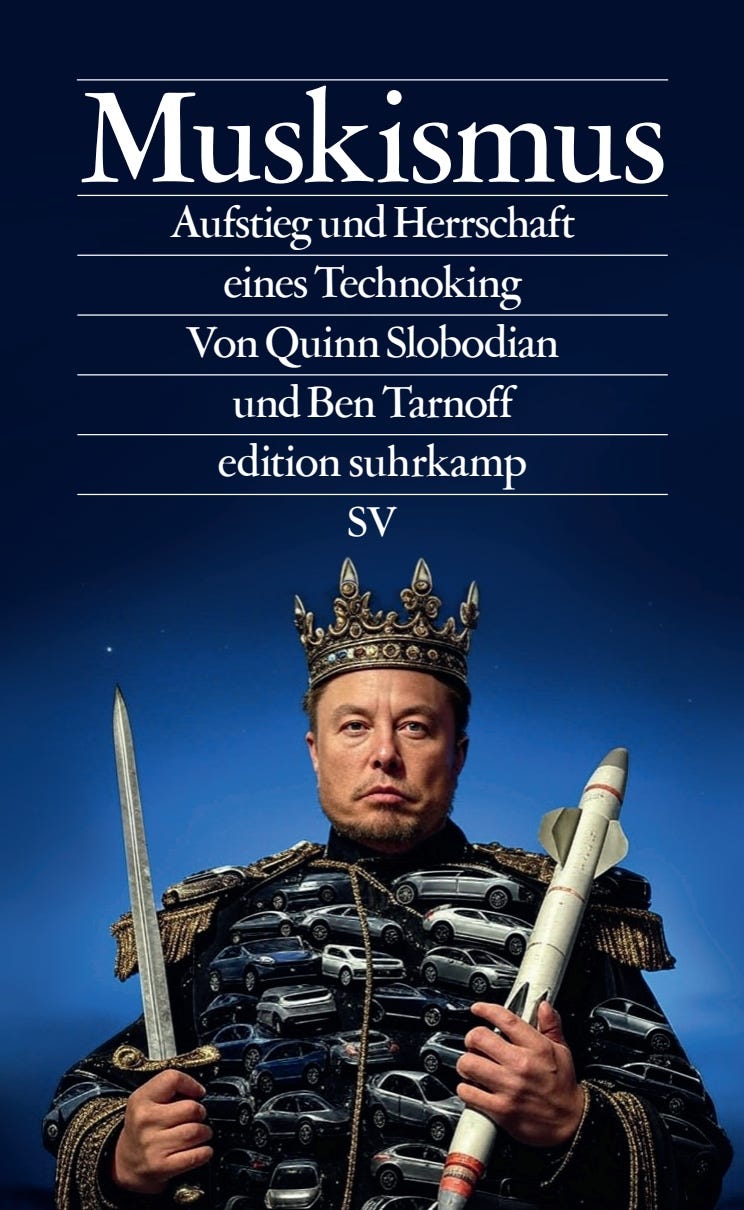
But the document also serves as a prime example of what Quinn Slobodian and Ben Tarnoff call “Muskism” in their new book, Muskism: A Guide for the Perplexed. They suggest that just as we thought of classic mid-twentieth century producer capitalism as Fordism, we should think of the new approach to economic organization that Musk and others are trying to put together as Muskism, and start figuring out how it works.
Slobodian and Tarnoff explain how Muskism involves both a particular approach to organizing physical production, and exoticized human-machine feedback loops. The former is briefly identified in the chunk of SEC filing above, by the four words describing Musk’s actual engineering approach: “vertically integrated innovation engine.” The rest of the text exemplifies a particular example of the latter: propagating a mythology of the future that is in fact a promissory note that you can turn into financial and political capital today.
Both are important. The vertical integration is as much a geopolitical as an engineering strategy, and shapes the specific ideas that get propagated. Equally, if you focus just on the engineering, you’ll miss out on the crucial role of cybernetic feedback circuits in shaping both the political and the economic project. Gigafactories are infrastructure, but as Slobodian and Tarnoff provocatively say, “trolling is infrastructure” too.
So below is a piece that is not a real review, but my own response to the book and where the project might go next. The two sides of Slobodian and Tarnoff’s argument address topics that I have been fascinated with for years, but have never been able to join together: geopolitics and political economy on the one hand, and the consequences of technology for democratic politics on the other.
Hence, I focus on the bits of the book that are close to my own obsessions, disregarding all sorts of interesting pieces of information that don’t fit. The purpose is to pull out ideas about the broader political economy that we might be able to build by thinking more clearly about the incoherence of Muskism, rather than the aspects that seem to fit together. As Slobodian and Tarnoff discuss throughout, Muskism also involves the increasing integration of infrastructure businesses with the state. How do ideology, production and state hybridization fit together? What is most valuable about the book - for my selfish purposes - is that it pushes us to start asking these questions. Equally, just as you had to move beyond Henry Ford to think about Fordism, mapping out all of this will require us to ask what Muskism would look like without Musk.
*********
Much of the first half of Muskism is about Musk’s approach to physical production. Some of the story has been told before - lessons from Silicon Valley; fail, iterate, fail better, eventually succeed; the move away from waterfall approaches (plan everything from above) to agile development (keep on revising the relationship between goals and means). What is new and extremely interesting to me is the relationship that Slobodian and Tarnoff identify between Musk’s approach to vertical integration and geopolitics.
The standard story we tell about high tech manufacturing in the early 2000s is all about outsourcing. Abe and I use semiconductor manufacturing as our example in Underground Empire - the modern semiconductor industry starts from the belief that it makes sense to separate design from manufacture, which has led to a complex production network involving myriads of separate firms. Much the same is true for the manufacture of laptops, iPhones or many other complex products. All of these involve contractors and subcontractors, engaged in an intricate dance of production.
Musk’s companies have tried, as much as possible, to take just the opposite approach. As Slobodian and Tarnoff describe it:
Musk’s drive to reduce his reliance on external suppliers and to concentrate production as much as possible within the walls of the firm cut against the globalizing currents of the 2000s, which positioned the factory as a node within an international production network woven together through supply chains. Muskism, by contrast, envisions the factory as an enclave.
For example, Tesla’s “Gigafactories” were intended to liberate Tesla from reliance on external battery manufacturers. Musk’s insistence on control meant that his companies were better insulated from geopolitics than many competitors. Equally, it sometimes forced him to make awkward choices. Tesla built Gigafactories in Texas, Shanghai, and then Berlin, giving him footholds in each of the major power blocs.
But if from one perspective, Muskism is a series of islands of production in different geopolitical zones, from another it’s an enclave that was built inside the confines of the American state. SpaceX had its origins in an effort to break away from the existing, heavily regulated approach that NASA took to spaceflight, and to the domination of the ‘primes’ - the big defense companies that understood the byzantine contracting procedures of the US national security state, and could navigate them. Vigorous legal activism and friends in high places allowed SpaceX to get contracts, and work actively to reduce costs by remaking the production process. As Slobodian and Tarnoff accept, this did result in real efficiency gains, while increasing the power of the private sector.
Admittedly, the company conquered the market in large part by achieving a dramatic reduction in launch costs. … But this cheapness came with a cost: the state would eventually cede its sovereignty to such a degree that it was forced to buy it back in increments from a corporation.
SpaceX’s launch model led to the Starlink satellite network. That in turn became “indispensable” to modern militaries, obliging then Undersecretary of Defense Colin Kahl to beseech Musk personally to allow Starlink to be used by Ukraine.
But Muskism is more than the relentless pursuit of efficiency. As the SpaceX SEC filing suggests, it has a strong ideological element too. Slobodian and Tarnoff say that Musk has long “spun persuasive science fictions to win the confidence of his investors.”
“Like the Soviet state dangling the promise of a radiant future in front of its tired citizens,” the critic Phil Jones observed, “Musk’s success is sustained by predictions of a technological sublime that’s only ever another decade away.”
They describe how Musk was eaten by the attention economy even as he was trying to devour it. I’ve paid attention to Musk’s relationship with the attention economy over the last few years, but I still learned quite a lot from Slobodian and Tarnoff’s telling of it.
Dogecoin provided a kind of entry drug - a joke cryptocurrency whose only value was what people attributed to it. Musk’s half-mocking enthusiasm helped pump up its price. Memes became ever more central to Musk’s self-image - as did half-baked cybernetic theories of how the circulation of beliefs and information might provide a collective countermeasure against evil AI. And then Musk began worrying about cybernetic contagion (he was latching onto a much older idea1 ), theorizing that anything that upset his preferred hierarchies was an example of the “woke mind virus,” which threatened to destroy humanity.
When Musk bought Twitter and turned it into X, he had his engineers goose the algorithms to ensure that people were relentlessly exposed to the prophylactic of his own received truths. Next, there were various amateurish efforts to re-engineer the Grok model so that it would deviate from its purportedly woke training data.
The general consequence has been to create ever more deranged feedback loops between Musk and the information structures that he has created, as illustrated by this New York Times article from last year. I’ve recently been re-reading a lot of Philip K. Dick for reasons, and this bit from The Transmigration of Timothy Archer sticks out:
he simply recycles his own nutty thoughts forever, enjoying them even though, like transmitted information, they degenerate. They become, finally, noise. And the signal that is intellect fades out.
Just so, except that Musk doesn’t give the impression that he is particularly enjoying his recycled thoughts. His own form of degeneration is darker and its consequences more vicious, despite the rhetoric about humanity’s destiny amidst the stars.
These two quite different tendencies - engineering for optimality and social media-driven promises of a radiant future - came together in DOGE, which both purported to remake American government on the basis of private sector efficiencies, and was named after a meme. The first is described by Sam Hammond of the Foundation for American Innovation in his encomium to “DOGEmaxing”
I concluded that, if we were ever going to transition to a more libertarian form of government, it would be essential to first use information technology to improve and streamline core government services in a way that creates space for crowding-in privatized forms of governance. … just as Marc Andreessen said “software is eating the world,” perhaps software will eventually eat the state. And nearly a decade later, it seems like this strategy for disrupting bureaucracy is finally coming to fruition in the form of Elon Musk’s Department of Government Efficiency.
The second is what we actually ended up with - a chaotic process of lopping off core aspects of government functioning that often seemed to be driven by whichever pustule of idiocy and malevolence had most recently appeared on Musk’s social media feed. Slobodian and Tarnoff conclude the last substantial chapter by saying that you can read the brief, sordid history of DOGE either as a story of overreach, in which Musk’s celebrity was incapable of transforming the state, or as a symptom of a deeper structural story, in which Palantir and Musk are nonetheless succeeding in reshaping the state in their image.
*********
Slobodian and Tarnoff’s final chapter provides four stylized accounts of where Muskism might go, each based on an exaggerated form of some particular element in their account. Another approach might be to ask how different elements, such as production, ideology and state fusion interact with each other. My best guess is that Muskism is more fragile than it might seem, and that the most likely place to discover fragilities is the crude joins between these different aspects.
Musk’s vertically integrated production model has insulated his companies from some geopolitical risks, so that they have adapted more quickly to a world of mutually suspicious sovereigns than many of his competitors. Equally, it carries its own risks and contradictions. Having factories in China and the EU as well as the US gives Musk greater clout, but also exposes him to a variety of governments, each with its own interests, each jealous to some greater or lesser degree of the others.
This has not been as much of a problem as it might have been thanks to Musk’s fraught but continuing alliance with Trump. Other countries that might otherwise want to press Musk, or even exclude him from their markets have to worry that they will find themselves on Trump’s shitlist.
The current situation of the world - enough geopolitical risk that complex supply chains are not the miracle of efficiency that they once seemed to be, but not so much as to actively endanger Musk’s companies in other parts of the world - seems well calibrated to Musk’s interests. He wants enough risk to drive people to rely on his island fortresses, but not so much that he can’t build or maintain them. But this temporary balance probably isn’t politically stable. As geopolitical tension accelerates, it becomes harder for Musk to straddle horses, forcing him to double down on American imperial hegemony.
That creates its own risks. Obviously, other countries may view Musk’s infrastructures as dangerous, fearing that they may be used against them. They have few alternatives to Starlink right now, or to SpaceX’s industrialized launch capabilities. But they are trying to build them, and may be able to substitute for other aspects of Musk’s empire, including the AI that is the purported source of SpaceX’s profit model. No-one - not even in Trump’s government - wants to use Grok if they have an alternative.
So too perhaps at home. Governments - including the US government - are increasingly open to the idea of nationalizing essential parts of economic infrastructure. Manufacturing, space launch and, as J.S. Tan and Kathy Thelen have argued, modern AI all involve big, physically immovable investments that can rapidly become captive assets if government becomes unfriendly. There is a lot of talk about moving data centers to space. One of the informal arguments I’ve heard bruited is that space based platforms might be less vulnerable to terrestrial government aggression, building on a somewhat different set of science fiction mythologies (Robert A. Heinlein and others on LIBERTARIANS IN SPAACCE!) than the cosmic destiny tropes.
All this is held together by an ideology that seems to be at its peak right now. The SpaceX IPO marks the massive expansionary inflation of an entirely imaginary universe. As far as I can tell, no-one actually believes that SpaceX is going to capture its roughly-$23 trillion “total addressable market,” which as Matt Levine points out is “perhaps 20% of the world’s economic output and perhaps 40% of the revenue of the world’s corporations.” But there are lots of people who are willing to go along for the ride for the moment, as long as other people are willing as well. How long can that last? What will happen to SpaceX and Musk when it begins to fall apart? The Musk bet seems to be that he can make himself an essential enough part of the world’s global economic infrastructure by the time that the crash happens that it won’t matter. A lot of things will have to go right for this to be true.
*********
This then suggests a broader agenda for figuring out what is happening in the world right now. What is most valuable in the long term about Slobodian and Tarnoff’s perspective is what they really don’t have the space to discuss properly in a short book that is aimed at a broader audience. They are emphatic in arguing that Muskism is a phenomenon that is broader than Musk himself, but they don’t have much room to talk about the non-Musk aspects. Fordism too was about much more than the vagaries of Henry Ford, who, like Elon Musk, was a deeply weird and unpleasant dude, with vicious conspiratorial beliefs. Some aspects of Ford’s approach failed (his desire to control every last aspect of the private lives of his employees). Some spread and became generalized (as aspects of mass production). Some led to compromises such as the grudging accommodation with unions that Ford himself would have absolutely hated.
It’s hard to even begin to articulate this question on a day where on the one hand Musk is enjoying his stock market apotheosis, and on the other is doing everything he can to stir up race riots. But what would Muskism look like without Musk? I take Slobodian and Tarnoff’s ultimate lesson as being that we need to move beyond Musk’s personality, and start thinking about Muskism or Muskismus (I like the German word, which is why this post has the German translation’s cover) as a mode of organizing production, as a generic ideology, as a set of political bargains, as a form of state-business fusion, or some weird amalgam of all four. If Muskism is going to change the world as its backers hope, it is highly unlikely to be because SpaceX manages to corner the entire global economy. If it fails, as I personally suspect it will, it is going to be because of the underlying contradictions that are getting papered over.
To figure this out, we might begin with the other businesses that seem to exemplify Muskism. Obviously, this would include Palantir, and a bunch of the defense-tech businesses funded by Musk’s adversary Peter Thiel. Thielismus starts from many of the same premises as Muskism, but with a different clatter of tacked-on lunacies (less cosmism; more prophecies of the Antichrist). Are there businesses that adopt some of the aspects of Muskism that Slobodian and Tarnoff acknowledge as useful (SpaceX has transformed the launch business) without all of the negatives? It would be useful to know: the waterfall approach to project management has not been good e.g. for Europe’s defense sector.
We might also want to ask whether Muskism is inextricably intertwined with US hegemonic power. What happens to the Muskist project if US hegemony fails? What happens to US hegemony if Muskism fails? How does Muskism compare to e.g. the explosion of Chinese domestic manufacturing, which applies sometimes similar ideas in a very different political context? Is small-d democratic Muskism a contradiction in terms? If not, what would it look like? If so, what are the democratic alternatives that might press back against Muskism, and what opportunities and tradeoffs do they represent?
And so on. We are in a world where an enormous amount is up for grabs. Muskism, across its various dimensions, is a project for grabbing as much as possible before anyone else figures out how to push back. Slobodian and Tarnoff’s book is valuable both in identifying the contours of the problem, and setting out an agenda for a broader political economy of the world that is taking shape today, right around us, that might provide maps for action.
Pliny the Younger described Christianity as a “contagious superstition” (superstitionis contagio) back in the day. I owe this to Cosma.
Comparing Musk to Henry Ford is a good starting place, engineers whose global reach had little to do with engineering once the empire was up and running. One big difference was Ford's core business was highly profitable. Musk's core SpaceX keeps getting used to hide his money-losing projects, which doesn't seem too stable. Add in that SpaceX is successful largely due to the work of its CEO Shotwell, not Musk, and all that's left is Musk's skill at handling investors. Krugman calls Musk a Ponzi scheme, hard to disagree.
This was the cherry on top of the delicious read:
"Pliny the Younger described Christianity as a “contagious superstition” (superstitionis contagio) back in the day. I owe this to Cosma."