

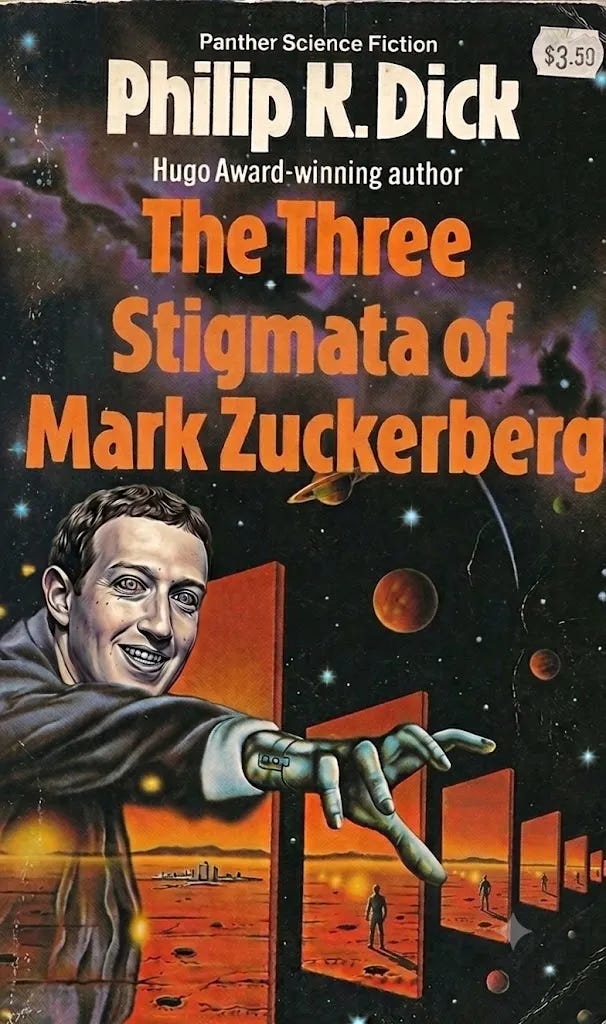
Dan Wang and I have written the Weekend Essay for the Financial Times, “Does Silicon Valley dream of Philip K Dick?” (update - non-paywalled links have been used up - so you will now need a sub to read this) I think it came out well. Nut graf, as they say in journalism:
Silicon Valley likes to dress its ambitions in the glistening garb of science fiction from the 1950s, when authors such as Isaac Asimov and Arthur C Clarke spun tales of humanity spreading through the stars. But what kind of future are we really hurtling towards? Increasingly, it is looking much more like the one anticipated by the drugged-up 1960s oeuvre of Philip K Dick, filled with deranged billionaires, machines that claim consciousness, hallucinated worlds and political breakdown. Musk and his brethren seem more like escapees from this universe than the Asimovian super-geniuses they imagine themselves to be. It is Dick’s far weirder sensibilities that offer the better guide to Silicon Valley today.
I’ve never before had so much artistic intelligence poured into framing a piece that I co-wrote or wrote. If I could, I’d hold a parade and medal-giving ceremony for whoever it was in the FT’s art department that found a photo hinting that Elon Musk’s SpaceX IPO took place in the Blade Runner extended universe. Indeed, the point of our essay is that the SpaceX launch did happen in some version of that universe, since that is the universe we live in.
Philip K. Dick wrote most of his great work in the period between the mid 1960s to the early 1980s, and he captured something very important about our current condition. Borges says in his essay, “Kafka and His Precursors,” that “[t]he fact is that each writer creates his precursors. His work modifies our conception of the past, as it will modify the future.” Once you read Kafka, you stumble across Kafkaesque moments in the past writing of those who themselves never read Kafka. For Dick, you don’t see those moments in other writers. You find them in the world all around you.
In many senses, Philip K. Dick was not a good writer. His prose was at best workmanlike. If you’re looking for a good novel in the traditional sense, he wrote maybe one? The Man in the High Castle has characters, plot, and enough space to properly let them play out. But (and there are many examples of this), you can be a great writer, revealing possibilities that others haven’t seen, without always being a good one. Dick’s best novels - I would name in addition to TMITHC, Martian Time-Slip, Ubik, The Three Stigmata of Palmer Eldritch - capture something that is both important and terrifying about the world. As Dick says in his essay, “How to Build a Universe That Doesn’t Fall Apart Two Days Later”:
The two basic topics which fascinate me are "What is reality?" and "What constitutes the authentic human being?" Over the twenty-seven years in which I have published novels and stories I have investigated these two interrelated topics over and over again.
But none of his universes were ever real in the first place. Nor, for that matter, is the one that we seem to inhabit at the moment. Again, from his essay:
So I ask, in my writing, What is real? Because unceasingly we are bombarded with pseudo-realities manufactured by very sophisticated people using very sophisticated electronic mechanisms. I do not distrust their motives; I distrust their power. They have a lot of it. And it is an astonishing power: that of creating whole universes, universes of the mind. I ought to know. I do the same thing. It is my job to create universes, as the basis of one novel after another. And I have to build them in such a way that they do not fall apart two days later. Or at least that is what my editors hope. However, I will reveal a secret to you:I like to build universes which do fall apart. I like to see them come unglued, and I like to see how the characters in the novels cope with this problem.
It is Elon Musk’s power to create universes, in which, provided that we provide him full scope for his ambitions, he will bring us to the stars. It is Peter Thiel’s power to impose his morbid fantasies about the Antichrist on the rest of us. It is Mark Zuckerberg’s, to create vast, self-replicating social worlds that seem to be emptied of any of the elements that make society feel meaningful. So too Sam Altman, who promises like Dick’s alien-infected business tycoon, Palmer Eldritch, to fulfil our every wish if we only grant him the control that he needs.
The reason that you read Dick with a terrified sense of recognition is that the shoddy pseudo-realities that he describes in his novels and short stories map onto the stories that we read in the news every day. All of these grand visions hide truths that are messier, more sordid and more contingent. It helps, of course, that we seem to be recapitulating the elements of his era that his fiction emphasizes: the cold war paranoia of the 1950s; the bitter political fights of the 1960s; Richard Nixon’s dreamworld of the 1970s. It helps too that the science fiction genre that he wrote in and criticized has become part of today’s dominating culture.
In the 1960s, Dick was already depicting the failures of that science fiction future: the consensual hallucination of cyberspace; an overheated world; Martian colonies that no-one wants to live in; machine intelligence that is ubiquitous and uncertainly alive; technology that never works as it should, while trying to squeeze every penny out of us that it possibly can. I read yesterday that BMW was running obligatory commercials for the new Spiderman movie on the digital dashboards of its car. If the ad had only been for the forthcoming Blade Runner 2099 miniseries, Ourobouros would have swallowed its own tail.
Dan and I are both “Dickheads” - passionate aficionados of Dick’s writing. I’ve written before about their resonance for today, though Dan is the one who has deeper knowledge of Dick’s fiction (and better jokes about it too). As we note in the piece, riffing on Ursula Le Guin, the great thing about Dick’s failed universes, indifferently crafted by incompetent demiurges, is that there are seeds of hope amidst the generalized paranoia. Reality, as he famously said, is that which, when you stop believing in it, doesn’t go away. Read rightly, Dick’s work suggests that we can get back to bedrock. Do read our essay. But read Dick’s own work too.
Welp, there goes that link again. I think FT is very fond of their paywall. But I have your November 2024 essay to keep me company for a while. I, too, am very fond of PKD--and Ursula K LeGuin, Samuel Delany, Tom Disch, and others of the Dangerous Visions era--and agree that his concerns are our concerns. He could see where we were (really) going.
Oh my goodness, Brother Farrell: out of the ballpark again. The ballpark that the protagonist Julia awoke to when she emerged from the dark reality of The Machine PKD acknowledged in TMMITHC that WE have created in our misbegotten drive for 'progress' and 'the future'.
A future for which this Boomer is as culpable as the next one: "Fuel Injection! Overhead cams! TV everywhere in your pocket!" Jesus. I'm hoping to find a 1930s GE Monitor Top fridge* to go with my 1927 bungalow kitchen, in FURTHER rejection of this madness, even if it does feel too late. (*They’re still out there, still working if you applied a couple drops of 3-in-1 to the motor bearings every year)
I don't want what they want. I don’t want what they want me to want. I further refuse, every day, to just shrug and participate in the Enclosures, Extractions and Enslavements being foisted upon us as 'necessary'. I want Enflourishment for my neighbors and those I love. And those I don't love, too. Although.... from an Irish curse: "May the Lord smite them in their ankles, that I shall know them by their limping".
Brilliant, sir. Many thanks for this extra splash of starch in my collar this morning.
Tim Long, Just Up the Hill from Lock 15