

Two pieces last week had sharply differing takes on the politics of Silicon Valley billionaires.
Andrew Hall is on a roll … Excerpt: “For most of the past decade, anti-billionaire language was a niche product. … In the weeks after an inauguration that seated tech CEOs in the front row and the dizzying drama of Elon Musk’s ill-fated DOGE experiment, billionaire mentions in Democratic emails quadrupled, peaking above 20 percent of all emails sent and holding around 15 percent ever since. Anti-billionaire fundraising tactics are now a mainstay of Democratic messaging.”
Yes, billionaire derangement syndrome is now a thing.
Elon Musk … now envisions SpaceX becoming “worth more than the rest of Earth” if it accomplishes its long-term goals. … Before anyone claimed that markets were efficient, political thinkers claimed that the self-interest of merchants would be a gentler master than the passions of princes. Albert Hirschman reconstructed this forgotten case in “The Passions and the Interests”. Montesquieu held that commerce makes manners gentle, le doux commerce. James Steuart thought economic complexity would restrain a prince more reliably than any constitution, since a ruler who wrecked the delicate machinery of trade would beggar his own kingdom. John Maynard Keynes put it plainly 150 years later: better that a man should tyrannise over his bank balance than over his fellow citizens.
… The self-interest of merchants did not tame the passions. It became infused with them, and turned the greatest of merchants back into princes carrying all the undisciplined appetites of old. They built a new and stranger tyranny: not the old corporate machine obedient to shareholders, but a machine that uses shareholder capitalism’s legal forms while escaping its restraints. SpaceX’s astronaut-in-chief is not maximising shareholder value. He is using the instruments of shareholder capitalism to raise enormous amounts of capital while freeing himself from any restraints from those who provide it, so that he can spend the proceeds on Mars, humanoid robots, artificial intelligence or whatever next satisfies his ambition.
Unsurprisingly, I think that the second of these is vastly more insightful than the first. But rather than comparing the pieces I want to hybridize them. Tyler’s riff on “Trump Derangement Syndrome”1 insinuates that you likely have a screw loose if you oppose the political influence of billionaires. But what if you turned this phrase against itself, and instead asked why some tech billionaires seem to be deranged?
Then, I think that you could weld it together with Tim’s basic argument to reach some plausible conclusions about how this happened. Under the wrong conditions, undisciplined princely appetites can transform into madness.
To be clear: this hybrid would be notably different to Tim’s argument, and likely actively objectionable to Tyler. I alone am to blame. But there is inadvertent support for some of its key elements from Peter Thiel, who is a surprisingly valuable chronicler of the conditions that give rise to billionaire derangement, as well as a living example of it (the Antichrist is among us!).2 Here, I’m drawing both on lectures that Thiel gave at Stanford, as summarized by his amanuensis Blake Masters, and the resulting co-authored book, Zero To One. These sources have a lot to say about the connections between entrepreneurship, kingship, and personal eccentricity.
The conclusion I draw is that the forces that Tim identifies, combined with specific aspects of the political economy of Silicon Valley, help explain the derangement of certain Silicon Valley billionaires and their epigones. Old style princes were notorious for their tendencies to deranged behavior, which came not just from their inbreeding, but their power, and the unwillingness and inability of others to contradict or check them. So too, modern princes.
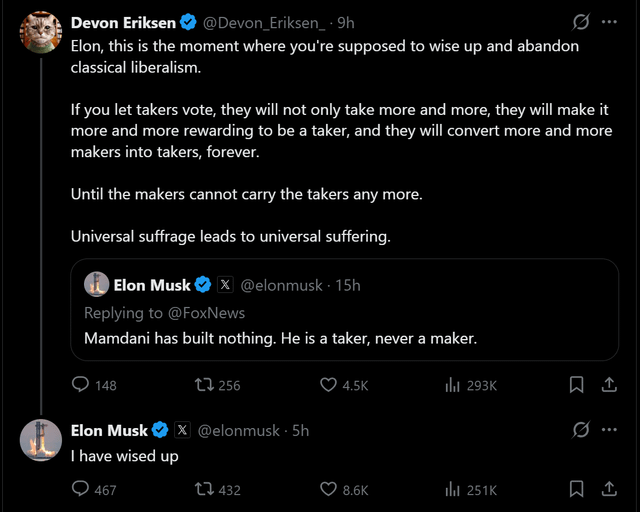
Not too long ago, many people, including Tyler, hoped that the advance of classical liberalism would go hand-in-hand with the growing power of tech billionaires, advancing both causes at once. Now, politically influential tech billionaires have visibly lost contact both with reality and with anything that could plausibly be described as classical liberal values. See the screen shotted quote above. Rather than making snide asides about billionaire derangement syndrome, it might be time for such people to confront what actual billionaire derangement means for the ideological straddle that they have relied on for so long. That is even more so, in a world where markets as well as market-makers are being devoured by the passions.
******
To summarize the particulars of my theory: Thiel’s lectures and book provide good, if incomplete evidence that the princely passions described by Hirschman didn’t disappear, but went underground. Commerce and power were fused into a new ideology of entrepreneurial virtù that became highly influential among the founder community in Silicon Valley. This combined with Silicon Valley’s (and popular culture’s) tendency to connect genius with eccentricity, not simply selecting people who seemed strange, but compounding their strangeness through self-reinforcing feedback loops. Finally, this all happened in an intimate social environment of founders and funders. Billionaires know each other and measure themselves and their success against those they consider peers, in a dense entangled clique that commingles high degrees of mutual influence with rivalries and jealousies.
Of course, all of these factors have benign as well as malign aspects. Entrepreneurial risk taking can be awesome; weird people are often more likely to be original; densely linked communities have many advantages. Furthermore, I would guess that none of these factors was sufficient on its own to precipitate the madness of princes that we see today. It is perfectly possible that they would have worked together in much more benign ways under different external circumstances. But we are in the world we’re in: one where the boundless appetites and irrationalities of a small number of billionaires seem increasingly incompatible with the need to maintain a stable civil society.
The victory of doux commerce was never complete. Economists like Schumpeter and Hayek deplored the encroachments of bureaucracy and treated disruptive entrepreneurialism as a kind of heroism. Schumpeter specifically argued that monopoly rents were needed to spur technological innovation.
These ideas about entrepreneurialism resonated with well connected Silicon Valley thinkers like Peter Thiel and Marc Andreessen (who regularly mentions Schumpeter as a source of ideas). Even more interesting, given Tim’s piece, is that they often went hand-in-hand with ideas about kingliness. Thiel’s Stanford lectures reportedly stressed the similarities between founders and monarchs.
A startup is basically structured as a monarchy. We don’t call it that, of course. That would seem weirdly outdated, and anything that’s not democracy makes people uncomfortable. But look at the org chart:
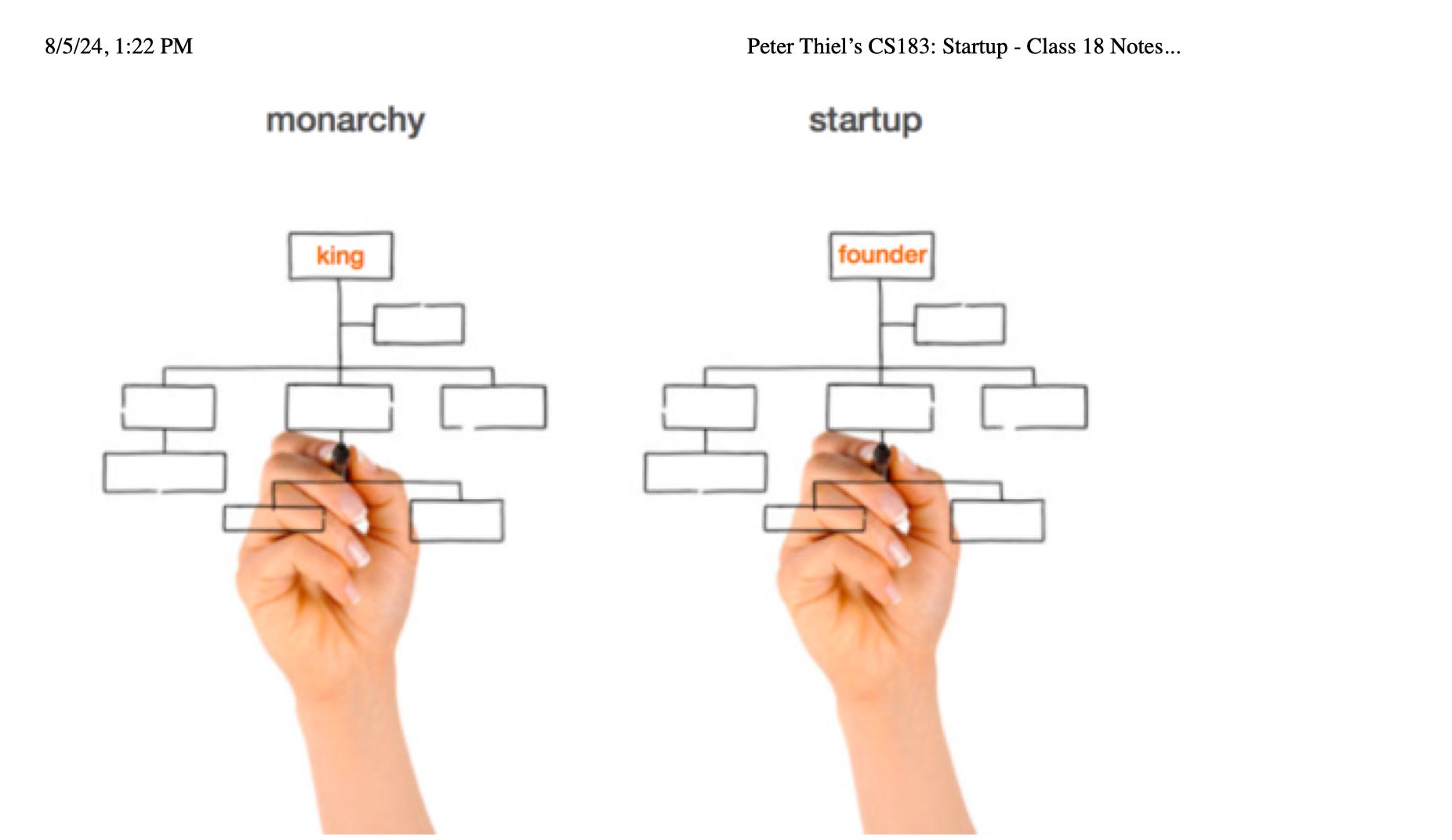
… Once a startup becomes a mature company, it may gravitate toward being more of a constitutional republic. There is a board that theoretically votes on behalf of all the shareholders. But in practice, even in those cases it ends up somewhere between constitutional republic and monarchy. Early on, it’s straight monarchy. Importantly, it isn’t an absolute dictatorship. No founder or CEO has absolute power. It’s more like the archaic feudal structure. People vest the top person with all sorts of power and ability, and then blame them if and when things go wrong.
This notion of the monarch as someone vested with “all sorts of power and ability” who gets the blame “if and when things go wrong” reflect Thiel’s Girardian hotchpotch of notions from The Golden Bough combined with management theory. For Thiel, kingship is a quasi-religious institution that combines the right to rule and the prospect of being sacrificed by the multitudes when things go bad. In three successive sections of Zero To One, “Where Kings Come From,” “American Royalty,” and “Return of the King,” Thiel and Masters emphasize the need both to cultivate a kingly myth and not allow it to dominate you.
Thiel also believes that you need not just to thwart socialist bureaucracy but to break out of the stifling confines of market discipline to get things done. The good stuff comes from convention breakers.
The usual narrative is that society should be organized to cater to and reward the people who play by the rules. Things should be as easy as possible for them. But perhaps we should focus more on the people who don’t play by the rules. Maybe they are, in some key way, the most important. Maybe we should let them off the hook.
Monopoly profits are what enable rule-breakers to achieve greatness and technological innovation, allowing them to escape the war of all against all that is market competition and establish more secure forms of dominion. From Zero To One
Americans mythologize competition and credit it with saving us from socialist bread lines. Actually, capitalism and competition are opposites. Capitalism is premised on the accumulation of capital, but under perfect competition all profits get competed away. The lesson for entrepreneurs is clear: if you want to create and capture lasting value, don’t build an undifferentiated commodity business.
… Monopolists lie to protect themselves. They know that bragging about their great monopoly invites being audited, scrutinized, and attacked. Since they very much want their monopoly profits to continue unmolested, they tend to do whatever they can to conceal their monopoly—usually by exaggerating the power of their (nonexistent) competition.
… In business, money is either an important thing or it is everything. Monopolists can afford to think about things other than making money; non-monopolists can’t. In perfect competition, a business is so focused on today’s margins that it can’t possibly plan for a long-term future. Only one thing can allow a business to transcend the daily brute struggle for survival: monopoly profits.
In short then, Thiel sees tech entrepreneurialism and kingship as intimately bound together: acting outside the rules to build the future that no-one else has the long term vision to grasp. “There have to be CEOs and founders. Those people are expected to wear the crown.” Monopoly is what enables you to do things that no-one else can do. Thiel is also a strong proponent of fending off bureaucracy and accountability as long as possible, so that founders can do founder stuff.
Of course, such ideas are not unique to Thiel or Musk. The “Silicon Valley Canon” is substantially made up of texts celebrating the willingness of great men to do great things, bringing together politicians, traditional tycoons and tech founders into a linear history of awesome overachievement by men who dared to do what no-one else would do.
Furthermore, as Thiel acknowledges, founders tend to be extreme outliers who get more extreme over time.
Thinking about founders … the dynamic might work like this. People start out being different. They are nurtured to develop their already somewhat extreme traits. Those traits become more important, and they learn to exaggerate them. Others perceive that inflated importance and exaggerate in turn. The founders thus end up being even more different than they were before. And we cycle and repeat.
Finally, Silicon Valley is highly cliquish. Both Zero to One and Thiel’s lectures depict the tech industry as a place where everyone who counts knows everyone else. Venture capitalists are closely interconnected. Founders and CEO's look at each other with a mixture of respect and jealousy.
Thiel describes how you want to build your company around a ‘mafia,’ and Silicon Valley is organized in ways that are not entirely unlike its Sicilian predecessor in its golden era. There is no central organization, but there are central cliques. You need to be connected to get things done. Ostentatious declarations of friendship and mutual interest go hand-in-hand with indirect threats, and the ever-present risk of betrayal. While the histories of the ‘Paypal Mafia’ do not reveal garrotings, shootouts and dissolutions of the bodies of opponents in acid baths (all part of the history of the Sicilian mafia - I once had to do a lot of secondary research), they are drenched with the sense that the Valley is ‘Our Thing.’ Figures like Peter Thiel and Elon Musk may possibly despise other, but also clearly recognize what they have in common that others don’t.
This is an environment in which ideas and modes of comportment may spread rapidly, both among true insiders, and those who aren’t inside but would dearly like to be. It has been quite entertaining, for example, to see Thiel’s theories of Girardian conformity spread among those who want to signal how hard they conform. And so too for other modes of relating to the world.
******
In short then, Thiel - both as reported by Masters and in collaboration with him - suggests that Silicon Valley is a place where being a founder is tantamount to being a king. You have a greater chance of succeeding if you are weird, and if you succeed, your weirdness will likely feed upon itself in feedback loops of positive reinforcement. Finally, it is a closely interconnected social system where the key people are conjoined in a dense tangible clique. They observe each other all the time, and are observed by others for cues of what you need to do to become a made man.
Thiel is, of course, not the only force in Silicon Valley, but he, and other Paypal Mafia members, including Elon Musk, have helped to shape an environment in which we might expect (a) the kinds of kingly notions that Tim talks about to be popular; (b) for personal eccentricities to compound upon themselves into active derangement, and (c) for both kingly ambitions and derangement to spread among a broader group of both principals and observers. And this is what we appear to be seeing.
SpaceX perhaps marks a culmination of the kingly ideal, a moment in which, as Tim puts it, someone like Musk can “raise enormous amounts of capital while freeing himself from any restraints from those who provide it, so that he can spend the proceeds on Mars, humanoid robots, artificial intelligence or whatever next satisfies his ambition.” But it is also the moment in which someone who is visibly profoundly disturbed has briefly become the world’s first trillionaire. And it is one in which others want to copy him.
Bringing together Tim’s ideas with deranged billionaire syndrome helps clarify how the stripping of restraints can combine with circumstances to produce a more generalized frenzy. As Hirschman said, it was the disorderly passions that the classical liberals wanted to escape from. Those passions regularly led to chaos and to madness. And now they are back.
I’ll finish by noting that this is just one aspect of a greater change. Deranged billionaires like Musk and Thiel are both partly responsible for this transformation, and notable symptoms of it. Still, they are not the whole of it. The reason that the SpaceX IPO temporarily succeeded, even though the numbers make no sense whatsoever, is that investment markets too are ruled by vibes. Tyler’s co-blogger, Alex Tabarrok, devoted years of his life to making the case for prediction markets, arguing that they would distill market wisdom into a more general source of knowledge on a multitude of topics. Now they are here, but all too often it’s spirits, not wisdom, that they seem to be distilling. Even more so for crypto. Matt Levine makes a joke about “Bleebzorx Tokens” to explain the worthlessness of memecoins, and someone else invents Bleebzorx Tokens to make a tidy profit.
We live not just amidst the madness of princes, but the madness of crowds. It might be nice for classical liberals to start thinking - and talking - more systematically about what this means for their understanding of the world.
The linked video - Bari Weiss’s self-congratulatory description of how she finally won the victory over herself - certainly deserves more discussion than it is going to get here.
Thiel’s musings on the Antichrist and existential threat of One World Government have been described by Tyler as “interesting and varied throughout.” I have no idea of whether this is a genuine compliment, or a modern version of the Victorian curate’s polite demurral regarding the suspect egg he is obliged to eat, that “some parts of it are very good.”

Funny that Elon and his sycophants would refer to the rest of us as “takers.” This coming from the guy who’s been handed billions of dollars of taxpayer money to start and run businesses that fail profitability for decades. And the only reason that Tesla is profitable now is because of a government program that allows the company to sell carbon credits. And where does a portion of the money for this program come from??? Oh, that would be from all of us “takers”. Our taxpayer dollars. Hypocrisy of the billionaire class, and their shills, knows no bounds.
Isn't it just as plausible that the self-interest of merchants was a gentler master than the passions of princes because merchants were many and had minimal power by comparison to the princes? Did any of the early theorists of state imagine the local dry goods trader having resources comparable to those of a princely state?