

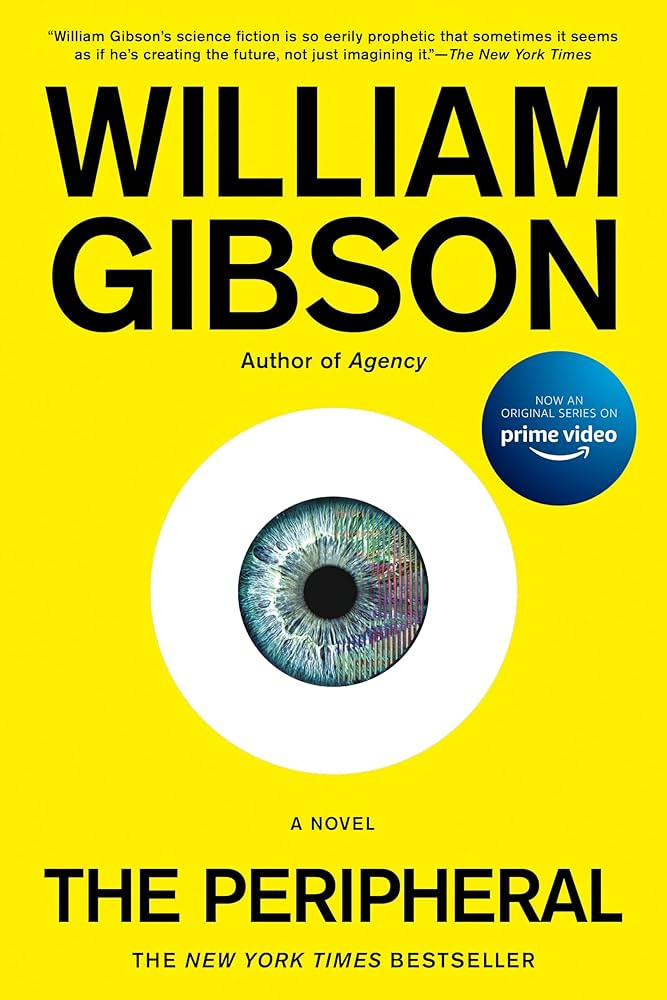
No new post this week - I’ve got an unexpected short term writing deadline. In lieu of that, I’m republishing (with tiny updates/edits) one of the best short pieces of criticism that I think I’ve ever written, on William Gibson’s novel, The Peripheral.
I’ve been thinking of putting this up for a while, but was pushed into doing it now by Andrew Brown’s complaints about Gibson’s greatly inferior sequel, Agency. In retrospect, Agency is a book of the short period when many people believed that you could return to a timeline in which everyone could see that Hilary Clinton ought to have won, if it hadn’t been for social media manipulation. This watered down the bleak realism of The Peripheral, which better describes the future we have found ourselves in. Warning for those who haven’t read the book: there are plenty of spoilers.
******
William Gibson’s The Peripheral time is the best novel of his late period, and in my view, the best novel that he’s ever written. It doesn’t have the shock value of Neuromancer (which blew my mind when I read it at the age of fifteen, in a small provincial town in Ireland). However, it’s a much better novel. The Sprawl books are all opaque and dazzling mirrorshades – the surfaces of high-gloss people reflecting the surfaces of high-gloss objects that reflect the surfaces of high-gloss people. The not-quite-science-fiction novels he was writing for a decade or two take the givens of the Sprawl books as a problem, engaging in a kind of archeology of objects and brand names, and how they reflect both the vast systems around us and our individual desires. I like them (they combine the intelligence of Don DeLillo with much of the warmth of Philip K. Dick), but I like his short book of essays, Distrust That Particular Flavor even better (it’s a book full of insights, which, like Borges’ version of Kafka, generates its own predecessors). The Peripheral returns to science fiction – but a science fiction that very clearly reflects present day concerns.
Gibson presents two timelines – one sort-of-nearish future, one several decades out again. They’re connected in some science fictional way that is never explained. The people in the further future are somehow able to access the past timeline (maybe the past timeline is a simulation so good that it’s effectively real; maybe it’s a parallel universe; nobody knows or seems to care particularly1). Physical contact between the two universes is impossible, but quite sophisticated forms of information can go back and forth, allowing people from the further future timeline to intervene in what used to be their past (as soon as they start intervening, the past starts to develop along a different path than the one that they know, becoming partly unpredictable).
What’s interesting is not the technology (which isn’t even a macguffin), but the uses that it’s put to. Gibson acknowledges the influence of Bruce Sterling and Lewis Shiner’s short story, “Mozart in Mirrorshades,” which depicts a future that uses alternative past timelines as a resource. I would guess that Paul McAuley’s criminally under-appreciated Cowboy Angels (in which an America on one timeline effectively colonizes and exploits other versions of itself in other timelines; our timeline is called the “Nixon sheaf”) is another significant influence. McAuley is thanked as an advance reader in Gibson’s acknowledgments. But Gibson doesn’t want to pursue the general questions of cultural appropriation that Sterling and Shiner’s story talks about, or the Cold War politics of McAuley’s book. He wants, I think, to talk about the relationship between the 99% and the 1%, using science fiction to turn the social relationships that Piketty and Saez talk about into a kind of ontology.
The farther future is one in which the 1% has won and become a global ruling class. A set of events called the “Jackpot” (a combination of environmental, technological and social failures) has led to most of humanity dying off. The results of the jackpot were rigged by the usual structural inequalities; those who were already rich and well connected were likely to survive; while those who weren’t so privileged mostly disappeared. This future is dominated by “klepts” (kleptocratic clans), the guilds of the City of London and the like, with the remnants of the state serving not as a restraint on the powerful but as an artifice for balancing between them (the politics is out of Engels via Poulantzas, with perhaps a touch of Wallerstein embedded in the pun in the book’s title). There may be ordinary people in this future, but we don’t see much of them; those we do see are the powerful and their higher servants (who have privileges, but only on the sufferance of those greater than they).
The nearer future timeline is set in a rural America where the real economy has collapsed, leaving people to survive making illicit drugs and working dead end jobs for homeland security (America’s comparative advantage turns out to be in meth, not music, coding and pizza-delivery). In this timeline, we don’t see the 1%, although they’re there in the background. Instead we see the kind of people who are about to be left behind and perish in the Jackpot.
Hence, the science fictional trick of The Peripheral, which is to turn the separation between the 1% and the 99% into a metaphor of physics (or, perhaps, information). The two literally live in different universes. They can perceive each other; they can act on each other to some degree (through proxies enabled by the exchange of information); they cannot physically touch each other. The rural America timeline is a curiosity owned by a minor member of a kleptocratic clan. A few people in it become significant by accident – one of them is operating a remote security drone in the further future timeline, and witnesses an important murder. A group of people who were peripheral, who were, indeed, toys, become important for a short period of time.
The result is a dark comedy, played with a very straight face. Two different factions start manipulating the entire world economy of the past timeline in order either to kill or to protect a tiny group of individuals in a small and depressed corner of rural America. One of these factions certainly seems nicer than the other (although that’s in doubt at some points in the narrative), but it’s not at all clear that its interventions will work out well in the longer run. At the very best, it’s acting like a Western aid organization in Somalia, trying to improve things a little, profoundly disrupting local economic and power relations simply by virtue of being there, and hoping that the goodies it brings will be used for socially beneficial purposes and not to enable ‘technicals’.
The novel finishes with something that plausibly resembles a happy ending for the individuals involved – complete disaster is averted, friendships are maintained across the barriers between the twin universes, and a few sympathetic poor people become rich and powerful. There are relationships, and one pregnancy. But the larger story is one in which nothing really changes. Perhaps the Jackpot (which is a lovely metaphor for the arbitrary-but-not-random rigged game through which people become or don’t become members of the elite) won’t be quite as painful, thanks to the intervention of benign overlords from the future. Even so, the one universe is still a toy of someone in the other. With less benign owners, things would be very different. The world depicted in The Peripheral is one where the best we can hope for is that our masters will be motivated by paternalism or benign neglect. That’s not an especially hopeful vision.
This is a terrific appreciation of The Peripheral's dual timeline confabulation (I have liked Ossian's characterization as the Oirish wide-boy with the shady past, but I never twigged the Flann O'Brien references. Well spotted!). My one exception or addition to your reading concerns the meaning of "The Jackpot." You've pointed out that concatenation of 'disasters'---ecological, technological, socio-economic, ideological, institutional---is a 'winner' for the stratospheric elites who later form kleptocratic oligarchies. I think this is facially true: outside of the dual-timeline McGuffins, there aren't effective ways for the future's invisible 90% to challenge Klept hegemony (in the post-breakdown future, world population has been substantially reduced). However, if the Klepts have climbed the piles of bodies to become kings-of-the-mountain, there seems to be 'some' gladiators' regret. At least a few of the future oligarchs willingly assist the super-intelligent AIs that are gaming their pasts into 'better' alternate futures.
By contrast, I think 'The Jackpot' mainly means the full, multi-factor breakdown of our 'advanced' democratic expectations and classical liberal institutions. It's a bit like taking James T Reason's 'Swiss cheese' security model to an apocalyptic conclusion: individual catastrophic breakdowns are, perhaps, individually survivable. But The Jackpot occurs when all the individual failures happen at once. The boundaries that might have succeeded in minimizing one or two disasters have been incapacitated by other disasters. When all things fall apart, the only survival and the only game remaining are for klepto-oligarchs to use advanced technology to secure their own and their appendages' survival. Even the Klepts might regret that their successes required the annihilation of billions of ordinary people, but the Klepts have prevailed in their diminished societies, and, for these Randian 'visionaries', keeping your eyes on amassing more comparative power is the only remaining game in town. It's the sympathetic, remorseful minor elites who gamble on creating futures where more folks survive still enfranchised with the distributed benefits of the liberal Enlightenment.
Lovely bit of cultural criticism of a great book. Trying not to get my hopes up about the third novel in what was to be a trilogy. Gibson's not talking about it, which is probably good news for its quality and bad news for how soon we'll read it.
If it's not too much trouble, could you post a reference for the (broken?) link to the Somalia document about "enabling technicals"?