

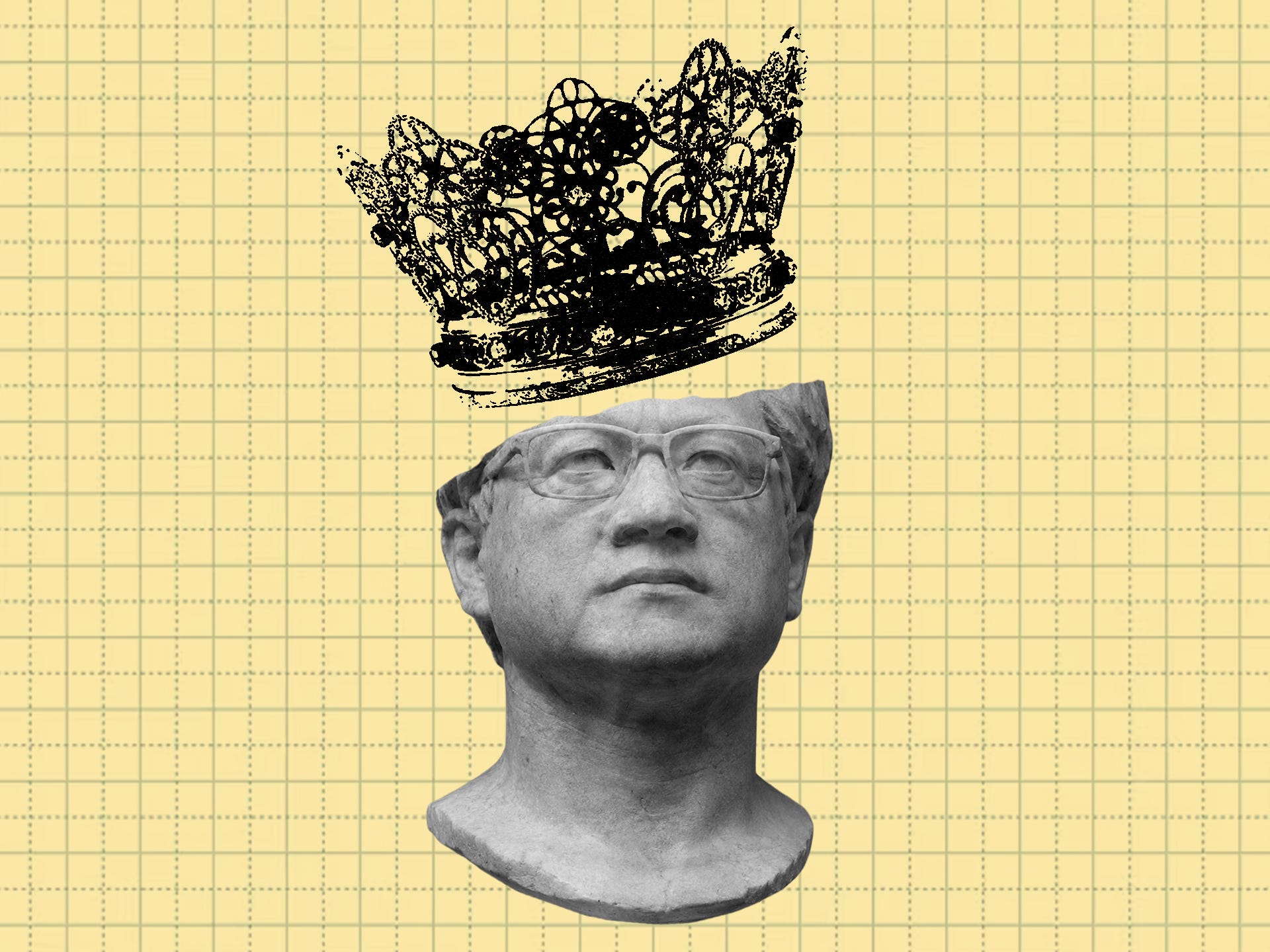
[image by Grand Tundra studio, for Grand Continent]
The below was written for Grand Continent, applying a bunch of ideas I’ve already talked about to analyze the current debacle. Grand Continent’s French translation is here; the version originale is below.
When Jensen Huang was fired as CEO of Nvidia, the Silicon Valley elite closed ranks around him. Travis Kalanick, who was CEO of Uber before his own disgrace, wore a leather jacket like Huang’s to express solidarity. Paul Graham, the founder of the enormously influential start-up incubator, YCombinator announced that “he has never known the tech world to be more unanimous about anything than they are about Jensen Huang. Everyone in tech thinks the board has made a huge mistake. Except the board. But they are not in tech.”
Now the tech elites have gotten just what they wanted. Nvidia’s board members unanimously decided to reinstate Huang as CEO, after “input from senior levels of the United States government.” President Trump has said that he asked them to bring him back.
This would have seemed an impossible outcome just a few years ago. Huang had affairs not only with two direct subordinates but a woman who is reportedly linked to a network that smuggles chips into China. He has exposed his company to immense ongoing political and legal risk. Huang’s reinstatement marks the merging of the Trump administration’s lawlessness with Silicon Valley’s detestation for accountability, in a moment where there is massive popular resentment of how politicians and tech executives are putting themselves above the law. Silicon Valley may soon deeply regret its Pyrrhic victory.
******
The second Trump administration’s disdain for accountability is reasonably well understood. Trump’s grasp of the executive and domination of the Republican party has combined with deference from the Supreme Court to allow him to mount a smash-and-grab raid on the American government. He has attacked his enemies, and hacked away at government capacity while making vast amounts of money for himself and his friends.
Silicon Valley’s approach to accountability is older and more complicated. As a rule, CEOs do not particularly like accountability or corporate governance, which gets in the way of their doing the things they want to do, but they are usually obliged to put up with it. Silicon Valley is different. As it has become more powerful, it has increasingly venerated founders. The entrepreneurs who create companies and the venture capitalists who fund them are depicted as having an unique capacity to see the future and create it, smashing the old so that new and better things can flourish. The proper business of Silicon Valley, and, by extension of the United States, is to enable these men of genius to do what they need to, for the general betterment of humanity.
Nowhere is this better reflected than in the writing of Peter Thiel, who was both a co-founder of Paypal with Elon Musk (they hated each other), and a funder of many other successful Silicon Valley companies. In a course on tech start-ups that he taught at Stanford in 2012, Thiel stressed that founders began as extreme people, and tended to become more extreme as they developed further. They didn’t care much about rules, and this was a good thing. As Thiel put it:
The usual narrative is that society should be organized to cater to and reward the people who play by the rules. Things should be as easy as possible for them. But perhaps we should focus more on the people who don’t play by the rules. Maybe they are, in some key way, the most important. Maybe we should let them off the hook.
Mere mortals’ role was to let entrepreneurs entrepreneur, even if they smashed the rules, economy and the world. Thiel’s venture capitalist partnership, the “Founders’ Fund” promised never to fire a founder. In 2024, the Fund notoriously hosted an invite-only event, “Hereticon,” to celebrate “technologies and projects so ambitious, they will ultimately transform our world for the better – or destroy it.” If you didn’t risk destroying the world, arguably you weren’t trying hard enough.
Entrepreneurs’ vocation, in contrast to ordinary humans, was to transform the world and strive for greatness. They needed to build monopolies, not because monopolies made money, but because they freed the monopolist from the need to pay attention to markets and competitors, and instead build the future according to their unique vision.
Others in Silicon Valley share Thiel’s belief that accountability gets in the way of good things. Kalanick’s Uber notoriously flaunted local laws, figuring that the way to success was to disregard rules and build market share, facing regulators with a fait accompli that would be politically difficult to overturn. As the platform economy got going, corporate governance shriveled away in many of the most important firms. Mark Zuckerberg as CEO of Meta, is responsible to a board. That board is headed and appointed by Zuckerberg himself. The board in turn is responsible to the shareholders, but they are collectively dominated by Mark Zuckerberg, the owner of the majority of voting shares. Facebook’s corporate structure of responsibility is Zuckerberg all the way down.
The ideology of impunity is obviously self-serving, but it is not just that. It has become intrinsic to the modern self-understanding of Silicon Valley. Nvidia, which was founded in an earlier era, has a more traditional corporate governance structure, which explains how Huang could be fired, despite his embrace of the modern Silicon Valley ethos and branding style.
When Huang was kicked out, it seemed like this ideology and the practices associated with it were under direct threat. If the CEO of America’s most important semiconductor design firm could be fired for sexual peccadilloes and skirting national security requirements, who knows who might come under fire next? This explains Silicon Valley’s ferocious response to Huang’s forced departure.
******
Now that Silicon Valley has gotten what it wanted, it may discover that it actually doesn’t like it. The American public is already deeply unhappy about AI, which became one of the key issues in the November election. There is already enormous anger about government corruption. The Huang affair welds both problems together.
The public anger against AI and data centers illustrates the downside of the Silicon Valley myth of unaccountability. People do not like being told that they have no agency over the future, or choice other than to adapt to the widespread disruption that brilliant and ambitious men have decided is necessary. As Jasmine Sun, who went out to talk to people protesting data centers put it in an interview with Ezra Klein, AI has become “an avatar for a small group of Silicon Valley billionaires’ ability to impose their vision of the world onto everybody else without their consent.” People hate AI because they see a future being built that they were never asked about and do not want.
Americans are just as unhappy about corruption. There has never been a president who is as baldly self-interested in making money from the office as Donald Trump. Connections to Jeffrey Epstein, influence-for-pay, pardons for well connected crypto crooks and blatant self-dealing all contribute to the perception of an administration that is profoundly corrupt, as some conservatives recognize.
The Huang affair connects the AI economy and government corruption together via a salacious sex and spying scandal. Nvidia’s deal making and subsidies are at the heart of the circular economy of AI. It also connects together the US and China. Smuggled Nvidia chips and access to offshore data centers with Nvidia hardware has helped Chinese firms follow closely behind the US frontier ‘labs’ in training and operating models. The Trump administration’s unwillingness to crack down on Nvidia was clearly problematic even for some Trump officials. That is why there have been so many leaks implying that Huang and Nvidia had political protection from inside. Now, the Trump administration is not only declining to rein in Nvidia, but actively interfering to reinstate a disgraced CEO.
It’s hard to imagine how this could look any worse for the US tech industry. The cult of the founder was already starting to sink under its own contradictions. Now, it’s going to be entangled with public corruption. Arguments from tech company leaders and lobbyists that AI regulation will hamper them from keeping ahead of China will fall flat. The US government is ostentatiously protecting a CEO with a close relationship to networks which appear to have been trying to help Chinese businesses steal a march on American technology. Very soon, the Democratic party will have the opportunity to call hearings, demand testimony from witnesses, and uncover more and more information about the sketchy relationships between the Trump administration and tech. Tech executives are likely about to discover that they cannot evade accountability forever, and the longer they hold out, the more trouble they are going to find themselves in.