

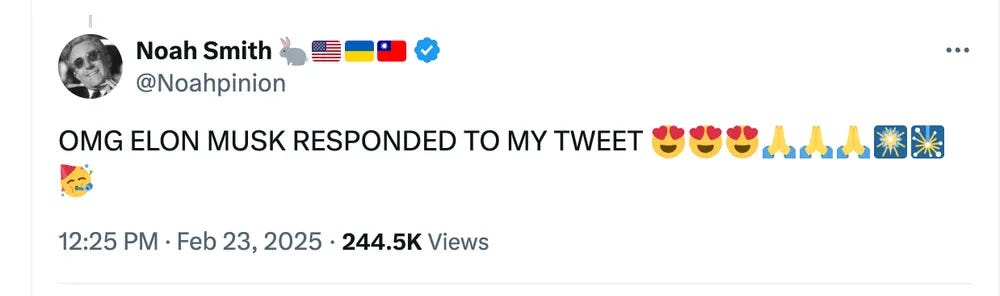
I didn’t expect to have more uncomplimentary things to say about the unfortunate intellectual relationship between (a few) economists and (a few) Silicon Valley billionaires right away. But Noah Smith republished his review of Daron Acemoglu and Simon Johnson’s Power and Progress this morning as part of a feud with Acemoglu and Johnson over whether we ought be trying to “steer” the development of AI.
A “timely repost” he says. Not so much. When Noah first put up his review, I responded, pointing out some of the things it got very badly wrong about the book it purported to describe. Then, he and Brad DeLong did one of their very occasional podcasts. Noah did not so much respond to any of the particulars as double down on his (again: obviously wrong) claims about the book without actually responding to any of the things I had said. I responded to that too.
Now, Noah is republishing the original piece with the note:
So anyway, here’s that review for you to enjoy. Hopefully it gets a few people to think a little harder about the AI-related ideas that Acemoglu has been promoting throughout the econ world, and why it would be a big mistake to make those ideas the default position of the economics profession on the AI issue.
I don’t for a moment think that Noah is a wicked person, but if there are economists who “need to think a little harder about … AI-related ideas,” he absolutely ought to be first in the queue. When Noah wrote his original review back in February 2024, it was to ridicule the notion that we ought worry about the power of Silicon Valley billionaires. That was an obviously bad argument then, but it is now much worse, given everything that has happened since.
So here’s my own “timely repost”: an edited and very slightly updated remix of relevant bits from the two very long pieces that I wrote in response to his earlier review and the podcast he did with Brad doubling down on his position. The TLDR of a very long post is that Silicon Valley billionaires do, actually, have power to shape political debate and get people to fawn over them, that Acemoglu and Johnson’s book is very valuable on this very important topic, that economists actually should adopt some form of their view as a default position, and that Noah himself should not be digging himself deeper, but trying to dig himself out, by admitting how badly he got things wrong back then. I don’t hold out much hope that he will: the even shorter TLDR is the screenshot at the top of this newsletter. Perhaps I will be happily surprised.
I don’t much like having to do this - I genuinely like Noah as a person - but I am startled and dismayed to see him resurrect claims that he should never have made in the first place. He has a lot of readers, and his failure to think hard and honestly about what he got wrong does them a great disservice. Repost below the fold.
******
Before letting rip, Noah says nice things about Acemoglu and Johnson, and I’ll do the same here for him. There are many on the left who detest Noah, but I know him to be a genuinely decent person. What I do think (and I’ve said more or less this to him in person - my views won’t come as news) is that Noah represents a style of economics that has an overly Panglossian view of power, economics and progress.
Many (but not all by any means!) economists just don’t like to think about power that does not involve visible coercion at gunpoint. They are especially resistant to the notion that power and ideas might be intertwined. Instead, being economists, they prefer to believe that ideas are intertwined with markets. Specifically:
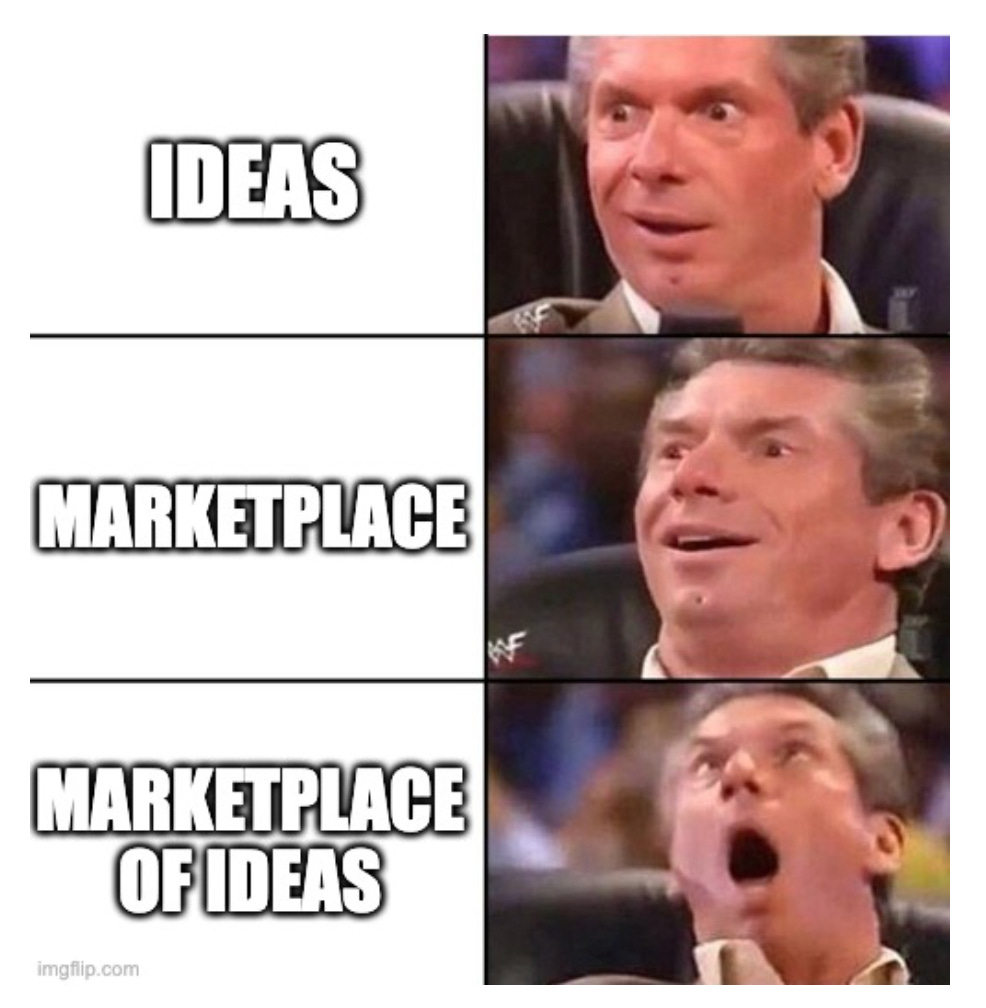
By gesturing toward this imaginary intellectual marketplace, in which everyone definitionally competes on an equal footing, they can wave away all counterclaims. Neither impertinent criticisms from non-economists, nor heretical anti-market arguments from fellow initiates can even scratch the surface of their magnificent assurance. Such counterclaims effectively become invisible.
That might seem like a rather strong hypothesis. But it is the only plausible theory I can come up with as to why Noah apparently can’t see the words and sentences printed on the pages that he read. There is a dizzyingly vast gulf between what Noah believes Acemoglu and Johnson are saying about power and what they actually say.
Noah says that Acemoglu and Johnson’s
entire chapter on power and persuasion left me bewildered. I do not understand why we should put accidental success in a nonviolent marketplace of ideas in the same conceptual category as chattel slavery and feudalism. [all Noah’s italics]
He suggests that Acemoglu and Johnson’s argument is both impossibly capacious and intellectually incoherent:
it’s clearly true that technology can be used to benefit average people or to hurt them. But how does society choose how to use technologies? Acemoglu and Johnson’s answer is “power”, from which they get the title of their book. But what is power? Here, in Chapter 3, Acemoglu and Johnson deploy a definition that veers into the tautological: “Power is about the ability of an individual or group to achieve explicit or implicit objectives. If two people want the same loaf of bread, power determines who will get it.”
Using this definition, how could we ever conclude that power wasn’t the reason for an observed outcome? Two people want a loaf of bread, and one of them gets it; we know this was due to “power”, because “power” is defined by who gets a loaf of bread. This kind of definition is semantically valid, but empirically useless; if you define “power” such that it simply means “whatever caused an outcome to happen”, you haven’t isolated causality, you have simply given it a new name.
Acemoglu and Johnson have a reason for employing a definition this infinitely broad; it allows them to include persuasion and compulsion in a single category of “power”.
In practice, according to Noah, Acemoglu and Johnson base their entire theory of power on the eloquence of techbro poasting. Specifically:
Acemoglu and Johnson believe that entrepreneurs … select from a menu of technologies, … to replace people or … that complements people’s labor … often they’ll choose the wrong thing. And not only will they choose the wrong thing, but they will use their quote-unquote power … persuading people [by] writing articles and … PR, … [and] their mighty power of blog posts … tweeting to … convince the world to allow them to invent the human replacing thing
Such an understanding of power is “useless and even counterproductive” since it assumes that “people just hearing arguments and deciding that those arguments are right means power has been exercised.” Power becomes a “residual” explanation: “[t]he only way you get there is by just assuming that all outcomes are due to power and then … applying the label power to whatever you think produces the outcomes.”
It isn’t unreasonable for Noah to want to know how to identify power when he sees it. Nor is it unreasonable for him to note that social scientists find it hard to prove that power inequalities caused this or that outcome, when the power dynamic doesn’t come out of the barrel of a smoking gun.
However, the fact that causation is really hard to isolate for certain social phenomena does not, ipso facto, mean that they lack causal force.
What Acemoglu and Robinson are saying is something quite different than what Noah depicts them as saying. For sure, they acknowledge that persuasion has some stochasticity. But they stress that it is not a series of haphazard accidents. Instead, under their argument, there are some kinds of people who are systematically more likely to succeed in getting their views listened to than other kinds of people. This asymmetry can reasonably be considered to be an asymmetry of power.
Noah claims Acemoglu and Johnson respond to the question “why are the tech bros so persuasive?” with a simple answer: “luck.” He says that he has found the killer quote:
They admit that quite a bit of the process of persuasion is random and declare that you are enormously lucky if you get the right idea, just the right ring to it at just the right time. … I do not understand why we should put accidental success in a non violent marketplace of ideas in the same conceptual category as chattel slavery and feudalism.
Let’s look at what Acemoglu and Johnson actually say! They do indeed argue that “all else equal, an idea is more likely to spread if it is simple, is backed by a nice story, and has a ring of truth to it.” But the problem for Noah’s interpretation is that they spend the next fifteen pages or so explaining at great length why all else is not equal, beginning with the very next sentence after the one that Noah quotes.
Acemoglu and Johnson argue that the success of ideas has some stochasticity - it is not a simple product of brute power. That is the burden of the sentence that Noah singles out as their core claim, and of similar provisos scattered throughout. But they certainly do not think that “success” is merely “accidental.”
For starters, Acemoglu and Johnson claim that the success of ideas depends on the “social status” of their originators and transmitters. Ideas that come from “respected cheerleaders” are more likely to spread. Social status is associated with success - we are hardwired to admire and imitate those who seem to be successful. But “societies and their rules” also shape social status and charisma: women and minorities have had enormous difficulty in having their voices heard, even when they have great ideas! More generally:
A huge amount of creativity, charisma, and hard work is no guarantee that an academic or entrepreneur will come up with an impactful idea. Prevailing beliefs and the attitudes of powerful individuals and organizations determine which ideas will appear compelling, rather than wacky or so ahead of their time as to be safely ignored.
Social networks also create power imbalances. Some people are very well connected. Others, not so much. Acemoglu and Johnson say that:
when it came to the power of big banks, it was not only ideas and stories. Bank executives and board members belonged to social networks that had enormous economic power and propagated these ideas. The big-finance-is-good idea was being repeated by economists and lawmakers, who were eager to provide theories and supportive evidence.
Furthermore:
It is not just the self-confidence and the social networks that powerful people have for propagating their ideas. It is also whether your voice is amplified by existing organizations and institutions, and whether you have the authority to counter objections.
Specifically this allows for important forms of agenda control:
The rules of the political system determine who is fully represented and who has political power, and thus who will be at the table. If you are the king or the president, in many political systems you will have ample influence on the agenda—sometimes you can even directly dictate it. Likewise, economic institutions influence who has the resources and the economic networks to mobilize support and, when necessary, pay politicians and journalists.
In short: theirs is not a simple theory of tweeting eloquence and accidental success! Nor, for that matter, is it an argument that starts from a “marketplace of ideas.” As Acemoglu and Johnson explicitly note:
the marketplace for ideas is an imperfect frame for technology choices, which are at the heart of this book. To many people, the word market implies a level playing field in which different ideas try to outcompete each other primarily on their merits. This is not how it happens most of the time.
To summarize: Noah’s Theory of Acemoglu and Johnson is as follows.
Techbros and entrepreneurs write blogposts and tweets in a free and thriving marketplace of ideas. Through luck and eloquence, the techbros persuade people that their arguments are right. This Is Somehow Power.
Acemoglu and Johnson’s Theory of Acemoglu and Johnson is just a little bit different.
Success in ideas is in part stochastic. Luck does play a role. But so do systematic inequalities. Specifically:
People who are perceived as more successful have higher social status and are more likely to have influence.
People who do not belong to disempowered minorities have higher social status and are more likely to have influence.
People who have dense connections to powerful economic networks are more likely to have influence.
People who have the ears of politicians are more likely to have influence.
People whose voice is amplified by existing institutions and organizations are more likely to have influence.
People who have substantial financial resources to sway journalists and experts are more likely to have influence.
This ain’t no level playing field market of ideas! Political, financial and social asymmetries have substantial consequences for who has influence and who has not.
Such inequalities of influence help explain something else that perplexes Noah: why Acemoglu and Johnson “explicitly try to rehabilitate the original Luddites,” and argue that these Luddites “were right to worry about knitting frames decimating their livelihoods.” From Power and Progress:
The Luddites themselves seem to have understood not just what the machines of the age meant for them but also that this was a choice about how to use technology and for whose benefit. In the words of a Glasgow weaver, “The theorists in political economy attach more importance to the aggregate accumulation of wealth and power than to the manner of its diffusion, or its effects on the interior of society.”
The Glasgow weaver still has a point, some two centuries later. Many “theorists in political economy” still attach importance to the collective accumulation of wealth and power, without inquiring closely how it is distributed, or what second order consequences it may have for society. Acemoglu and Johnson are, of course, themselves political economists, but they look to push back against some of the main tendencies in the field.
There are two parts to the Glasgow weaver’s complaint. One is a distributional concern: in their words, economists usually pay more attention to aggregate social benefits than how those benefits are diffused to particular groups in society. They all too readily leap from a broad utilitarian-philosophical claim - that we ought maximize on some notion of the general social benefit - to the empirical assumption that if we maximize aggregate benefits at time t1 we can expect that the distributional problems will sort themselves out in some proximate future period, t2. More crudely put: they assume that if you let ‘progress’ rip right now, the particulars of who gets what will sort themselves out in some broadly acceptable way in the future.
According to Noah (in the podcast), Acemoglu and Robinson’s argument is that “entrepreneurs … select from a menu of technologies, … to replace people or … that complements people’s labor … often they’ll choose the wrong thing.” Under this interpretation, Acemoglu and Johnson are wrong, because they believe that entrepreneurs have the foresight to envision what their technologies will do to labor in the future. Noah is then moved to launch into an extended fantasia on how “after combing through” the book, he has failed to find a “scrap of evidence” for the proposition that entrepreneurs and technologists can foresee the consequences for labor of the technologies that they invent, and how various tech folk and entrepreneurs are terrible at predicting the future.
Again (I regret that I have to keep saying this), this is not what Acemoglu and Johnson say. They do not claim that entrepreneurs make a single choice over technologies that they might get right or wrong, leading to the one path of development or to the other. They do not worry that tech people are prophetic geniuses, fiendishly choosing the worst possible human future so as to maximize their personal advantage. Instead, they fear that the bros’ unseeing ignorance leads to over-reach, but that their choices may nonetheless become self-reinforcing because of the mutually reinforcing intersection of influence, technological development and political power. Again, it is worth reading their actual written words:
Those enriched by new technologies, or whose prestige and voice are magnified, become more powerful. Technological choices are themselves defined by dominant visions and tend to reinforce the power and status of those whose vision is shaping technology’s trajectory. This self-reinforcing dynamic is a type of vicious circle. Students of history and political economy have highlighted such dynamics, documenting the pathways that make the rich politically more influential and how this additional political power enables them to become richer. The same is true of the new vision oligarchy that has come to dominate the future of modern technology.
In other words, economic inequality tends on average to compound into political inequality, and inequality of social influence, in a kind of feedback loop. And even the feedback has feedbacks! Just as social influence is magnified by economic clout, so too social influence can translate into economic and political benefits. Hence:
persuasion power generates strong self-reinforcing dynamics: the more people listen to you, the more status you gain and the more successful you become economically and politically. You are thus enabled to propagate your ideas more forcefully, amplifying your power to persuade and further boost your economic and political resources. This feedback is even more important when it comes to technology choices. The technological landscape not only determines who prospers and who languishes, but it also critically influences who holds social power. Those enriched by new technologies, or whose prestige and voice are magnified, become more powerful. Technological choices are themselves defined by dominant visions and tend to reinforce the power and status of those whose vision is shaping technology’s trajectory.
There are long standing battles about feedback processes within the profession of economics. Many economists - in particular right-leaning economists - Do Not Like increasing returns processes because they mess up a lot of the economic standard arguments for market efficiencies. But at this point, I think that most reasonable economists accept that feedback helps explain how some trajectories of technological progress get locked in, and why some get locked out. So Acemoglu and Johnson take that one step further, arguing that technological trajectories are shaped by political and social feedback in ways that will magnify the influence of elites, absent strong countervailing forces.
If (a) there are different technological trajectories, (b) these trajectories have long term distributional implications (they lock in economic patterns of who gets what), and (c) this in turn affects the distribution of political and social power, then you can’t assume that these problems will sort themselves out in some fair and equitable fashion in the long run. They will not: instead, whatever solutions are created in the future will reflect inequities that are being generated today.
The second part of the weaver’s complaint is a social concern - that maximizing on aggregate wealth and power may have adverse effects for society, and may hurt some groups particularly badly. This of course, fades into the distributional problem, but it has some broader consequences too. Again, there is an unfortunate tendency in the mainstream of economics towards a callous calculus of the ultimate good, in which the travails of those who suffer through economic adjustments are regarded as sad, in some abstract and generalized way, but a necessary cost of building a better world that will manifest itself at some hazy point in the future. At the extreme, this can turn into statements like Nassau Senior’s infamous quip that the Irish famine “would not kill more than a million people, and that would scarcely be enough to do much good.”
Acemoglu and Johnson are not responding to sentiments as vile as those of Nassau Senior. But I suspect that they are familiar with the attitude of much of their profession to workplace innovations that seem to improve ‘efficiency’ at the expense of making workers’ lives worse. For example, algorithms including machine learning algorithms, are having more immediate consequences within the U.S. workplace, as illustrated by this Bloomberg article on Amazon’s work practices. Rather than making the customer wait, Flex drivers ensure the packages are delivered the same day. They also handle a large number of same-day grocery deliveries from Amazon’s Whole Foods Market chain. Flex drivers helped keep Amazon humming during the pandemic and were only too happy to earn about $25 an hour shuttling packages after their Uber and Lyft gigs dried up.
But the efficiencies come at a stark human cost:
the moment they sign on, Flex drivers discover algorithms are monitoring their every move. Did they get to the delivery station when they said they would? Did they complete their route in the prescribed window? Did they leave a package in full view of porch pirates instead of hidden behind a planter as requested? Amazon algorithms scan the gusher of incoming data for performance patterns and decide which drivers get more routes and which are deactivated. Human feedback is rare.
… former Amazon managers … say the largely automated system is insufficiently attuned to the real-world challenges drivers face every day. Amazon knew delegating work to machines would lead to mistakes and damaging headlines, these former managers said, but decided it was cheaper to trust the algorithms than pay people to investigate mistaken firings so long as the drivers could be replaced easily. …
Inside Amazon, the Flex program is considered a great success, whose benefits far outweigh the collateral damage, said a former engineer who helped design the system. “Executives knew this was gonna shit the bed,” this person said. “That’s actually how they put it in meetings. The only question was how much poo we wanted there to be.”
From the perspective of management, algorithmic bedshitting is wonderfully efficient! It costs less, and is much less of a pain in the ass. And if drivers have to piss into bottles in their vans because they fear being punished by the algorithms, then so be it. This is a cost that they pay, not investors, nor managers, nor customers.
Whether Noah cares to acknowledge it or not, the perspective of people like Amazon Flex drivers is less influential on decision making than the perspective of certain other groups. As Acemoglu and Johnson mention in their bibliographical essay, there is some very solid empirical research - and by economists too! - explaining situations in which power-as-social-influence has been very consequential indeed! Specifically, Elliott Ash, Daniel Chen and Suresh Naidu FOIA-ed the hell out of George Mason University, and combined the results with other data. They wanted to discover what happened when right wing foundations paid for judges to attend seminars in nice resorts, with great food and drink, where they listened to Milton Friedman and his mates explaining The Virtues of Free Markets, the Evils of Government Regulators, the Benefits of Chicago School Antitrust Doctrine, and the Healthy Incentives Provided by Harsh Criminal Sentences.
The evidence shows, unsurprisingly, that the judges were influenced! Not only were there measurable long term consequences for the judges’ decisions after they were wined and dined but there were secondary consequences, via social influence osmosis, for other judges whom the first set of judges worked with.
Noah would like to believe that we live in a thriving “marketplace of ideas.” Ash et al. focus in contrast on ideas of the marketplace, how rich people have shaped them, and how in turn, they are reshaping U.S. society. Again: this ain’t no residual account. There’s actual econometrics! These findings were published by the National Bureau of Economic Research, an organization that Noah is possibly familiar with. Oh happy marketplace of ideas, where the Scaife Foundation and Amazon Flex workers alike can try their luck, and hope for accidental success in influencing federal judges!
So how do we create a situation in which other voices than those of accidentally eloquent billionaires like Elon Musk can have some influence on debates over tech policy? Succinctly, Acemoglu and Johnson want MOAR equality and MOAR democracy. The first borrows from J.K. Galbraith’s notion of countervailing power:
We need to reshape the future by creating countervailing forces, particularly by ensuring that there is a diverse set of voices, interests, and perspectives as a counterweight to the dominant vision.
The second derives from a more recent body of findings about problem solving and social cognition, which I and various co-authors have also drawn from.
There is also another reason for democratic success: cacophonous voices may be the greatest strength of democracy. When it is hard for a single viewpoint to dominate political and social choices, there are more likely to be opposing forces and perspectives that undercut selfish visions imposed on people, regardless of whether they want them or benefit from them.
and
The democratic advantage may not be just the aggregation of separate views, but rather the encouraging of diverse perspectives to engage with and counterbalance each other. The strength of democracy is thus in the deliberation among different viewpoints, as well as in the disagreements that this often generates. Hence … a major implication of our approach is that diversity is not a “nice to have” feature; its presence is necessary to counteract and contain the overconfident visions of elites. Such diversity is also the essence of democracy’s strength.
When Acemoglu and Johnson talk about “steering,” they are suggesting that it is better not to leave crucially important decisions to the techbros, but to have them decided democratically through processes that allow ordinary people to have some countervailing power against elites. The downside of democracy is that it is slow, conflictual, and a massive pain in the arse. The upside is that it allows people with different interests to defend their interests, and to collectively draw on diverse understandings of the world for a more complex mapping of plausible future developments. And when you are making decisions that may set patterns in stone for very long periods of time, you really want those who are affected by these decisions to have a say.
If Acemoglu and Johnson are right, our children and grandchildren may not be dealing with technology-produced problems in circumstances of their own making. Instead, the trajectories that determine who makes the choices, who, indeed, defines what is a problem and what is not a problem, are being shaped today and tomorrow and tomorrow. When increasing returns intersect with political and social influence, it is perfectly plausible that the decisions we make right now could dramatically constrain the ability of people in the future to make decisions at all.
Moving away from democracy towards a fuller embrace of market awesome may radically undermine the capacity to exercise democratic choice later. Plumping for the new vision oligarchs, and continuing to support them over time, potentially vitiates collective choice through democracy in order to encourage unbound marketism, with a side-order of unbridled authoritarianism should folks like Musk, Thiel and their ilk get their way. That is what is at stake in Noah’s fight against Acemoglu and Johnson. And that is why both his criticisms and the blinkered perspective that they emerge from get the situation we are in so badly wrong.
I know that in the spirit of playing the ball and not the man you have to add caveats to these sorts of pieces about their subject being a good guy etc., but in the case of Noah he has exhibited a track record of intellectual dishonesty across many, many different topics that is truly startling. At some point such a consistent record of bad faith argumentation should make it not so controversial for him to be labelled a bad actor. He is of course free to write whatever he likes but anyone remotely close to the levers of power should be warned away from listening to him.
There is no one writing on these topics today who has a greater disparity between the size of their audience and the quality of their analysis than Noah Smith.
My first experience with him was 6 years ago, back when he was purporting to be a professional "China Watcher" (he does not know any Chinese, does not understand Chinese culture) and he repeatedly humiliated himself with basic misunderstandings. His approach has always been to double down or ignore obvious errors and contradictions. I do not know why people read him. He is not a good writer, he is not funny, he is not insightful.