

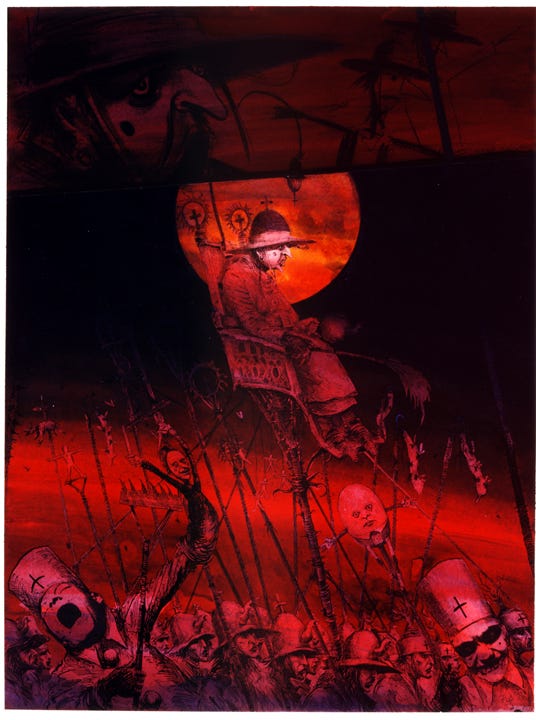
[The Procession of the Mammy by Ian Miller, from M. John Harrison and Ian Miller, The Luck in the Head. I own both the graphic novel and the original illustration, so will substitute a better scan when I get back from traveling].
M. John “Mike” Harrison just won the Booker Prize, to everyone’s surprise, including his own. He’s one of the great writers of our era, and perhaps the best single chronicler of the time we’re in, but most people probably hadn’t heard of him before last night. I imagine many people are uncertain where to start so here is my guide. NB that I am still in the early stages of the book, The End of Everything, that won the prize, though I have read the short story that it began from.
The TLDR is that Harrison has been walking ahead of us for decades into a strange and uncertain future. That he has received the Booker (with generous comments from judges suggesting that they very much get what he’s up to) suggests that we’re finally beginning to catch up.
You can’t and shouldn’t describe Mike as a science fiction and fantasy writer; you can’t and shouldn’t describe him as not being one either. When you say that someone has a complicated relationship to a genre, you are usually committing a euphemism. In Mike’s case, it is the visible truth.
The best way that I can explain it is that he has taken the limitations of these genres and used them not as an excuse for escaping into “literature,” but as a means for mapping the limitations of literature too; its difficulties in capturing the realities of a world that is being rebuilt by technology and suffused by fantasies and science fictional dreams that regularly resemble the worst and most limited extrusions of genre fiction. As he put it in a 2003 interview.
My feeling about escapist fiction has softened a little down the years but it has never really changed. I think it's undignified to read for the purposes of escape. After you grow up, you should start reading for other purposes. You should have a more complicated relationship with fiction than simple entrancement. If you read for escape you will never try to change your life, or anyone else's. It's a politically barren act, if nothing else. The overuse of imaginative fiction enables people to avoid the knowledge that they are actually alive. (In fact, various evasions, various kinds of fantasy, seem to me to be a kind of bad politics in themselves, the default politics of the day, through which we maintain our Western illusions of freedom and choice.)
And more specifically, describing his short story Egnaro:
The whole of Western Society is based on the idea of “if I want it I should be able to have it.” The world, we tell ourselves, much the way the Edwardians did, is now under control and all that remains is to guide it into the exact shape of our dream. Two things are wrong with that. The first is that our world is only under control because we ship our chaos and garbage elsewhere. The other, what control freaks never understand, is that you can’t control the whole of a situation. It is like squeezing a balloon. Compress it in one place, it bulges out somewhere else.
The world is not a L’Oréal ad. We do not live inside our own advertisements. “Egnaro” was a recognition of the West’s tendency to swan-dive into its own mythology. “Egnaro” is the beautiful world of the corporate ad, in which dolphins swim alongside our car, simultaneously delighting and blessing us, and making us feel “natural” even as we wipe them out as a species. Excuse me, we don’t live in a world like that. We are not going to be able to live in a world like that.
Harrison’s early work involved him working his way out of writing the kinds of fantasy novels that Michael Moorcock turned out in a week of whiskey drinking to help keep the magazine New Worlds afloat (Harrison was the magazine’s literary editor) to something that maintained some of the form, but put it to radically different uses.
I first found him through his early A Storm of Wings, which I read when I was sixteen or seventeen. I disliked it intensely on first reading, but something about its uneasy blend of far future fantastic and high modernism caught at me, worried me, made me come back to it. It was merely an imago of what would eventually break out (what had already broken out, in more mature work that I hadn’t then come across), but it was enough to get me going.
When Harrison’s work really began to flower was in three books he wrote in the late 1980s and the early-to-mid 1990s: Climbers, The Course of the Heart, and Signs of Life, as well as a flourishing of short stories. Climbers is a ‘realist’ (the quote-marks are necessary, unnecessary, and an in-joke) novel about a man who takes up climbing after his marriage breaks down. The Course of the Heart is about the irruption of the fantastic (a seedy Prometheus, a toxic marriage; a magical ritual gone wrong). Signs of Life is barely-near-future science fiction, a little like what William Gibson was writing at much the same time, but also, very much, its own thing.
The first two novels, and one of the short stories that the third builds out from1 contain the same scene in identical or nearly identical language. The same problem plays out in very different ways across them. A collision between the real world and an imagined one, which somehow seems better, denser, more real than reality itself, but is in fact a reflection of it. A moment of choice, connected with that collision, in which everything seems, for a moment to be possible. The falling away of that moment, as reality reasserts itself, so that the moment of choice recedes forever into the past, but still haunts the world, present as a sense of possibility and of failure, each entwined so closely with the other that you cannot tell where the one ends and the other begins.
Harrison began to get popular acclaim, in the United Kingdom at least, for the three books that came next, the Kefahuchi Tract books, Light, Nova Swing, and Empty Space, which turned some of his past work inside out, repurposing space opera and bits of the Strugatsky brothers to get at the ways in which even if we spread out to the stars, it would not be an escape, because we’d bring ourselves with us. Something in those books didn’t catch me, though the realistic parts of the third involve an absolutely extraordinary depiction of a middle-aged woman (Harrison is interested in women in a way that most male writers are not). That, I loved.
And so we get to the most recent books, The Sunken Land Begins To Rise Again, Wish I Was Here, and the prize-winner, The End of Everything, which I haven’t yet finished. I wanted to write a piece that brought all three together - I’ve been meaning for years to write a piece on the political economy of Sunken Land, which is less about Brexit than the circumstances and history in which it arose - strange exchanges of information; a landscape of layered strata of history, in which things repeat themselves but keep losing the track of what they were saying:
Beneath sphagnum and hart’s tongue and crusts of dead leaves over black mud lay the contorted and paradoxical strata from which, for almost a thousand years, the local profits had been gouged. Coal for the Cistercians in their abbey; then limestone; then iron and clays for the ironmasters, with their Silicon Valley rhetoric, their promises of a future, their estates called Paradise or Heaven. Further down, above the old railway line, a thin waterfall spattered at the back of a quarry; light fluoresced electrically in the moss.
I’ll try to do that, sooner rather than later.
It is not coincidental is the moment at which Harrison’s work has really begun to get broader interest and acclaim. The political and moral entropy he describes in his very early story, “Running Down,” (which tackles some of the themes that re-emerge in Sunken Land, but more simply and directly); the confusion of fantasy and the real; the construction of vast science fictional dreams of universal flight that keep on landing us back in the mire and shit. That is the world around us, and we are finally beginning to see it. AI gurus like Elon Musk claim to be building some bland and delightful future along the lines of that predicted in Iain M. Banks’ Culture novels. Banks in fact shared Harrison’s sensibilities: his introduction to a collection of Harrison’s Viriconium stories celebrated not only Harrison’s delight in the particular, but the understanding of the “faint, not even ironic hiss” of entropy that suffuses everything that Harrison writes. LLMs are only the latest, and perhaps most literal, version of the fabulous anti-syntax drive that will propel us to the stars.
At last, we are beginning to catch up to where Harrison has been at for a long time. I can’t do better than to finish with his own description of the new novel and what it sets out to do:
One of TEoE’s major differences from an ordinary post-disaster story is that its core event is an explanatory collapse, a cloud of unknowing. This is not a side issue, it is the nature of the disaster described in and by the book. …. Everyone in the book has an opinion about what’s happened: everyone in the book’s opinion is different: that doesn’t amount to a condition describable as “knowledge”. And yet that’s exactly where we find ourselves now. In an age in which speculation is daily offered as a means of managing the real; in which the consumers and editorial staff of a middle class newspaper or broadcast can no longer claim to have any better handle on the world than AN Other Conspiracy Theorist. …
One of the first things about epistemological failure is that you don’t know what you don’t know. A novel which makes that its central thought–and which rigorously passes that condition on to the reader–offends every possible traditional idea about the novel: about the hallowed privilege of knowing and the controlled communication of that knowing to a reader. No wonder the odd Goodreads feather gets ruffled. On the other hand I’m charmed to meet so many readers who have no difficulty whatsoever with these concepts.
It’s delightful that those readers include the Booker Prize committee, which awarded the prize unanimously. I know that he’ll have been particularly delighted that one of the judges compared the book to the stories of Katherine Mansfield, who is one of his touchstones. This is wonderful news altogether.
I’m traveling (if you are at the Web Summit in Lisbon say ‘hi’) which means I don’t have access to my library right now.
“If you read for escape you will never try to change your life, or anyone else's.”
His interviews aside, you’ve convinced me to read some of his work