

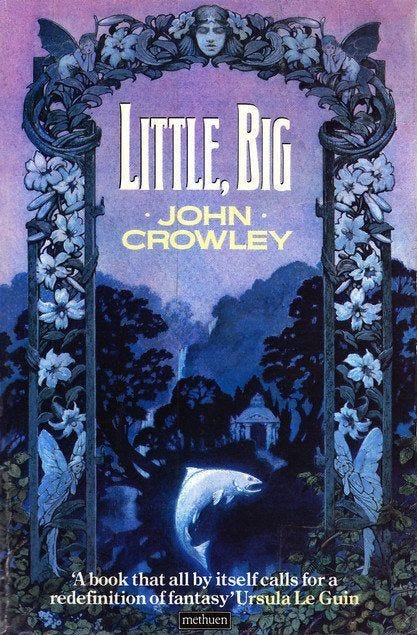
According to various sources, John Crowley has died. Even if you don’t know who John Crowley was, you quite likely have been indirectly affected by his work. If you read at all in the space where science fiction and fantasy meet literature, you’ll almost certainly have read someone who knew his books, and very likely loved them. Ursula Le Guin described Little, Big as “a book that all by itself calls for a redefinition of fantasy.” Susanna Clarke said in her long ago Crooked Timber seminar that she too had read Little, Big, and I think that it shows. Her most recent book, Piranesi, draws on Borges’ Library of Babel, but I suspect that it was influenced too by the memory palaces that Crowley built, on foundations laid by Dame Frances Yates. As James Hynes described Little, Big in the Boston Review.
it is a long, gorgeously written, picaresque family saga, in the last fifty pages of which all the major characters, with one heartbreaking exception, turn into fairies. I’ve read Little, Big four times now, and wept shamelessly each time over those last, extraordinary fifty pages, and over the years have purchased and given away fifteen copies of it (when I could find it–it is inconsistently in print). When “You’ll love this” isn’t recommendation enough, I have proceeded to claim (as I’m claiming here) that Little, Big is an Important American Novel that bears comparison to such works as One Hundred Years of Solitude and Nabokov’s Ada.
Me too, on the tears, the giveaways, and the importance. Every time I see a copy anywhere, I buy it, later to press upon some unsuspecting person who seems a likely prospect.
I could keep going. Kim Stanley Robinson admires Crowley’s non-f/sf book about Roosevelt’s dream of industrial America, Four Freedoms. Francis Spufford’s Nonesuch owes nearly as much to Crowley as it does to Narnia, and at one point practically quotes the thesis of Crowley’s extraordinary long story, “Great Work of Time.”
I don’t mourn Crowley because of his influence on others, but because of how his writing shaped me. I mention his work often in my own writing, but have never talked about it in its own right. What Crowley wrote is too deeply and intimately entwined with my sense of my own self for me to to be able to view it from the outside.
When I think about Little, Big, I remember being twenty-one, walking up the hill from work to my family’s house in a small town in Tipperary in Ireland. I had bounced off the book the first time I read it, but for some reason felt pulled back to try again, and read and re-read it, falling in love with it as I have never fallen in love with a book before or since. Walking up the road on a temperate summer afternoon, thinking about the book and how it folded back into the world and itself, felt like a quiet explosion of joy in my chest.
When I think about Aegypt, it is a memory from a year earlier, taking a long train ride from New York to Toronto to visit friends, and rounding a bend to see what was obviously the original for Butterman’s castle. Decades later, when I read the short story “This Is Our Town,” collected in the small Totalitopia volume, it seemed to me a version of my own childhood, transplanted to a small American town; an ordinary Catholic boyhood, whose suffusions of the supernatural were painstakingly captured with the apparatus of the fantasy genre.
I got to know Crowley very slightly via email, as he wrote his final book, Flint and Mirror, which was set in Ireland before and during Hugh O’Neill’s rebellion. It was a bitter war. My and Maria’s ancestor Turloch Breasalach was a contender against Hugh for the O’Neillship. Our family tree records that out of twelve sons that Turloch Breasalach had alive at the beginning of the Elizabethan wars, only three were surviving at the end of it. Crowley wanted to use the book to talk about colonialism. The brutal war and its aftermath set some of the parameters for what Britain did later in other parts of the world. John Dee, who appeared in Flint and Mirror as well as several other Crowley novels, was not just a wizard but an imperial propagandist.
There’s a single word in Flint and Mirror that I helped shape; a tiny return for the way in which Crowley’s work shaped me. The wave that sinks a ship in the last part of the book is the third wave, because in Donegal folklore, the third wave was the fairy wave that you had to beware of. I passed that on to Crowley from a story that my and Maria’s grandaunt Maire MacNeill translated from Irish, “The Knife Against the Wave.” Since Crowley loved reading fairytales as well as writing them, here it is. I will miss his writing very much.
The Knife Against the Wave
Long ago a fine able handsome man named Séimín Rua was living at Baile Mór. He and his crew went out fishing with lines to Cúl Fastó an Chladaigh Bháin, a fishing ground in Donegal Bay.
The day changed and the sea rose and it seemed they would be wrecked. Séimín was in the stern of the boat and saw a monstrous wave coming at them. He pulled off one of his shoes and threw it out against the danger. Before long he saw a second wave coming at them: he pulled off his other shoe and threw it out and the sea calmed a little but this was only a short respite. It was not long until the third wave of the sea rose at them and each one of the seven thought that this one surely would drown them. There was a big bait-knife stuck in behind the stern-seat. Séimín caught hold of it and threw it against the danger. No sooner had he done so than the sea fell and became as smooth as a board.
They came home then drenched to the skin and when they reached the shore their families were there waiting for them for they thought by the way the day had changed and the sea had risen they would never see them again. No wonder there was great rejoicing for them. When they had divided whatever fish they had caught and moored the boat they all went home.
Well and good. When darkness fell Séimín was sitting beside the fire, his soles to the warmth, all the neighbours in and he telling them about the hard day they had had. With that, there was a bang on the door. Someone went to open it and who was standing on the threshold but a rider on a white horse! The rider asked if Séimín was within and was told he was. The rider called from the door:
“Séimín,” he said, “I would be very thankful if you would come with me to such a place to pull out the knife you cast into my sister’s heart today!”
Séimín recognized immediately what kind he was. “I will not go out the door on such a journey unless you promise me that neither you nor any of your kind will ever harm me or anyone belonging to me.” “I promise you that,” said the rider, “and I promise you as well that you will be left back home safe and sound before daybreak tomorrow.”
Séimín went with the rider and he neither heard nor saw anything until the white horse came to shore on the Red Strand at Mullaghmore in Connacht. The horse continued on to a crag at the top of the strand where a door opened into the hill and the horse entered. Before long they reached the finest castle Séimín had ever seen. The rider tethered the horse and led Séimín inside. They went upstairs and he was taken into a room where a girl was lying. The bait-knife he had thrown against the dangerous wave was stuck in under her heart and she was screaming with pain.
“Come here,” she said, “and pull this knife out of my heart!”
“I will do that willingly,” said Séimín, “if you promise me you will never harm me or anyone belonging to me.”
“I promise you that,” she said.
Séimín drew out the knife and she was healed. “Why did you try to drown us today?” asked Séimín. “Because I am in love with you and would like to have you for myself.”
“And you were going to drown the whole crew because of me!” “I was,” she said. “I would do anything in the world to get you for myself.”
“Well, you won’t get me,” said Séimín. “I must be on my way home.”
The rider of the white horse was standing at the door waiting for Séimín who mounted behind him, and the horse never stopped until he was left at the door of his own house. The rider bade him farewell and Séimín saw him no more from that day until the day of his death.
Oh no, so sad to hear! He was my advisor for my senior year project and I took a few classes with him. Really nice and always had constructive things to say, even on the ramblings of mildly pretentious undergrads
This is an essay on John Crowley that is worth several weeks reading, delving into what’s mentioned. If I had a lifelist of books read, I could check to see what’s missing. But at this point, i see it as a seminar in mostly things I’ve missed, to add to my pile TBR. Thank you, @Henry Farrell.