

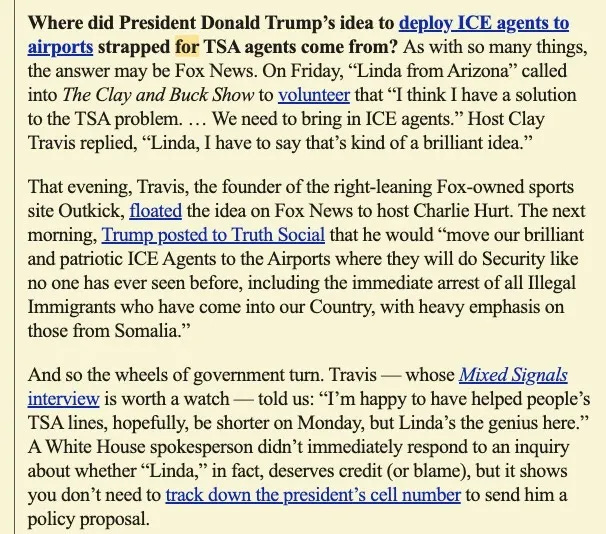
I’ve been thinking about this post for a few months, but haven’t wanted to write until I felt I had the argument right in my head. I think it gets at something useful, but it could very easily be misconstrued. It explains why the above (via Matthew Gertz this morning) plausibly describes how policy gets made in the Trump administration.1
“Gooning Towards the Führer” is not a claim, either express or implied, that America is descending inexorably into Nazism. I obviously detest Donald Trump and what he is doing to America and the world, but I do not believe for a moment that he is akshually Adolf Hitler.
Instead, I think that some of the historical literature on the Nazi state (Ian Kershaw obviously; also Jane Caplan and bits from the late Detlev Peukert’s work on Weimar) is extremely helpful in thinking about how Trumpism works as a style of policy making. Kershaw compares Hitler’s chaotic mode of making and implementing decisions to Stalin’s more orderly bureaucratic approach. Both, obviously, were far more monstrous than Trump at his worst, but just as they had different styles of dictatorial rule, you could distinguish, say, between Trump’s approach to competitive authoritarianism and Viktor Orban’s.
There are also some very important differences in policy making style. Hitlerism was jerry-built on top of imperial Germany’s bureaucratic state, and could still rely on bureaucratic proceduralism to get things done. Trumpism, in contrast, leans very heavily on social media to coordinate policy across the regime. Propaganda and policy making are blurred so that one can’t tell where the one ends and the other begins. One of the aspects of Trumpism that is most difficult for people to wrap their heads around is the degree of overlap between the channels that the regime uses to communicate with the public, and the channels that the regime uses to communicate with itself.
Hence, Kershaw’s notion of “working towards the Führer” isn’t quite appropriate for understanding what is happening now. Trump’s underlings absolutely try to anticipate his desires and get his attention. But they do this by adopting a particular style, which is well suited to a small set of questions, and terribly suited to a much larger one.
This has consequences. First: ideas and arguments that aren’t readily translated into a particular language of visual memes have a very poor chance of making it through the process. Second: there are regular fuckups, as notions that make for great memes or Fox News talking points turn out to make for shitty and self-defeating policy actions. Third, problems that cannot be translated into the language of memes and Fox News hits don’t really exist for the Trump administration,until they cause complete breakdown, and sometimes not even then.
This, then, can all be described as “gooning towards the Führer.” More below.
**********
Ian Kershaw’s phrase, “working towards the Führer,” has escaped its original context, but it is absolutely worth going back and reading what he meant to argue with it. Kershaw was writing in the 1990s, right after the collapse of Soviet rule over Eastern Europe. People were making sloppy comparisons between Stalinism and Nazism as largely identical forms of “totalitarianism.” Kershaw wanted to argue that there was something different about the “gathering momentum of radicalization, [and] dynamic of destruction” of Nazi Germany. Stalin was a “man of the machine” who gathered his power from within the bureaucracy. In contrast, it was “hard to imagine” a “party leader and head of government less bureaucratically inclined” than Hitler. Kershaw quotes one of Hitler’s former adjutants:
Hitler normally appeared shortly before lunch, quickly read through Reich Press Chief Dietrich's press cuttings, and then went into lunch. … as even worse. There, he never left his room before 2.00 p.m. Then, he went to lunch. He spent most afternoons taking a walk, in the evening straight after dinner, there were films. He disliked the study of documents. I have sometimes secured decisions from him, even ones about important matters, without his ever asking to see the relevant files. He took the view that many things sorted themselves out on their own if one did not interfere.
This hands-off approach meant that Hitler, without formally intending it, “presided over an inexorable erosion of ‘rational forms of government.” The result was a system of rule that combined local islands of efficiency with a remarkable degree of general chaos.
Stalin had a system that survived him, but Hitler did not. Hitler’s organizing will was the system, such as it was, leading to a ceaseless dynamic of radicalization, based on “predatory character and improvised technique,” with no visible braking mechanism. Stalinism was based on bureaucratic technique, while Nazism was organized around Hitler’s personal charisma.
Most importantly, the Führer served as enabler: “Hitler's authority gave implicit backing and sanction to those whose actions, however inhumane, however radical, fell within the general and vague ideological remit of furthering the aims of the Führer.” This was how ‘working towards the Führer” actually functioned. Hitler himself rarely issued unambiguous commands, instead preferring to let arguments between his underlings sort themselves out, and communicating his preferences elliptically, when he communicated them at all. Kershaw takes the classic phrase from a speech by a provincial Nazi functionary:
Everyone who has the opportunity to observe it knows that the Führer can hardly dictate from above everything which he intends to realise sooner or later. On the contrary, up till now everyone with a post in the new Germany has worked best when he has, so to speak worked towards the Führer. Very often and in many spheres it has been the case - in previous years as well - that individuals have simply waited for orders and instructions. Unfortunately, the same will be true in the future; but in fact it is the duty of everybody to try to work towards the Führer along the lines he would wish. Anyone who makes mistakes will notice it soon enough. But anyone who really works towards the Führer along his lines and towards his goal will certainly both now and in the future one day have the form of the sudden legal confirmation of his work.
**********
There are obvious similarities between working towards the Führer and policy making in the second Trump administration. A boss who rolls in at lunchtime to read the press clippings has a lot in common with one who reportedly spends much of his day napping, playing golf, gossiping with friends and watching cable TV. There are also obvious differences. Again: Trumpism is not Nazism. Trump’s faults are volubility and incoherence rather than elliptical indifference (though he too, clearly does not like disciplining underlings).
There are important differences in the administrative problems faced by Trumpism and Nazism. Detlev Peukert argued in his book on Weimar that the Third Reich inherited a sympathetic (and largely effective) bureaucratic apparatus. The Nazis didn’t feel Trumpism’s need to strangle a “Deep State” that they saw as antithetical to their interests and goals. Bureaucrats were often prepared to go along with their program, and sometimes enthusiastic about it. In Government without Administration, Jane Caplan documents the incoherence and infighting inside the Nazi state, but the internal wars were usually waged through traditional bureaucratic communication channels such as memos.
There is still a lot of traditional bureaucratic policy making happening, even under Trump, but the key tools for coordinating top level policy aren’t formal bureaucratic documents. They are Signal messaging groups which we can’t (usually) see, and social media channels and cable/broadcast media, which we can.
The latter two are underestimated as a mode of policy coordination. There is a lot of discussion of the Trump administration’s intense relationship with social media. For example, this Politico article on how the administration tried to sell the Iran war:
A second senior White House official who is also closely involved in the video-making effort described it as a collegial, creative endeavor. “We’re over here just grinding away on banger memes, dude,” said the person, also granted anonymity to speak candidly. “There’s an entertainment factor to what we do. But ultimately, it boils down to the fact that no one has ever attempted to communicate with the American public this way before.”
But that is not all that is happening. “Banger memes” aren’t just being used to communicate with the public. They are being used to make and coordinate administration policy.
If you are trying to get Donald Trump’s attention, maybe you can just pick up the phone and get lucky. Even journalists sometimes manage this. But that isn’t going to work often, and may backfire badly if he doesn’t like what you are doing. So if you want to change public policy, you may instead want to do something that is highly meme-able; perhaps you actually meme it. That will be more likely to start doing the rounds, and maybe even attract the attention (and re-Truthing) of the Big Guy himself.
This is not “working towards” so much as “gooning towards.” For those who aren’t familiar with modern slang, ‘gooning’ is an Internet term of art for turning what Irish Catholics like myself once called the solitary vice into a highly sociable activity.
I am late middle aged and easily weirded out by what the young folk do these days - but there is a possible secondary meaning of gooning that is more deeply problematic. The Trump administration has become addicted to creating - and consuming - social media featuring masked and tattooed goons roughing up protestors, flexing biceps covered in politically sketchy tattoos, and dominating the libs. These days, Trumpism is all about getting off on a 24-7 flow of goon video content, which infects not just how the administration sells policy, but how it does it. The medium isn’t completely the message, but it absolutely shapes the kinds of messages that can, or cannot, be communicated through it.
**********
Putting the two pieces together, we live in an America whose influencers and officials are professionally obsessed with gooning towards the Führer. They desperately want Trump’s attention, so they can further their own aims and careers in an administration whose ordinary processes of policy discussion have broken down. The best way to get Trump’s attention - or just get ideas circulating - is through putting forward highly goonable proposals, or even directly gooning them up through creating memes, AI generated video, or highly misleading cable news hits of goons-crushing-protestors/immigrants/liberals.
Putting ICE agents on the line at airport TSA checkpoints, with or without masks? 1000% goonable! Who cares whether it will work or not. Gaming out whether Iran will block the strait of Hormuz before carrying out bombing strikes on its leadership? Boring!
Competitive gooning in a highly chaotic environment is a kind of factory for bad and self-defeating policies. If officials’ best way to advance their careers is by gooning it up for just one scatterbrained individual, they are regularly going to end up doing stupid things.
Take, for example, the harebrained idea to target Jerome Powell with subpoenas. As best as I can tell, Trump administration leaks that this did not originate from the White House are credible. The policy seems, instead to have come from Bill Pulte, a former memecoin influencer who got a mid-level administration position. Pulte discovered that he could get Trump’s attention by targeting his enemies with bogus investigations - but did not have the minimal political intelligence to understand that there are some enemies that You Do Not Go After, because they are too powerful and dangerous.
Such mistakes are likely to be endemic in a policy regime founded on competitive gooning. Furthermore, when officials come back with proposals for compromise, they will always risk being shot down by gooning rivals, or even by the Gooner-in-Chief. Compromises are not goonable unless they are done by the man himself, in which case they demonstrate Sublime Mastery of the Art of the Deal.
The more subtle consequence is that issues, problems and questions that are not goonable will become invisible. This isn’t always bad: some problems are sufficiently dull that the remaining bits and pieces of the federal government can continue to grind away at them in obscurity. But it is bad often enough.
To understand this, it is useful to consider traditional bureaucracy and goonability as alternative (and mostly incompatible) technologies of attention. Any political system faces the core problem of what it should pay attention to in an enormously complex world, and how it should pay attention to it. The US federal government, in all its creaking inefficiency, has many systems that are designed for just that purpose: to discover important problems, simplify them into abstractions that can be grasped, and to offer potential solutions. This is often dull and tedious work, but it is important. Much of it involves carving off the parts that don’t require top level attention to be dealt with in the middle realms of policy making or elsewhere.
The pathologies of Seeing Like a State - of failing to observe or understand problems that cannot be broken down into simple metrics and regularized categories - are very well documented. The state can’t easily coordinate its activities to deal with problems that cannot be expressed in terms that it understands. The pathologies of Seeing Like an Idiot are worse understood, because we haven’t had to think so hard about them. They don’t just involve ineptitude and blunders, but a nearly complete incapacity to see or talk about the much wider set of problems that can’t be expressed via goonposting. By and large, the abstractions of goonability carry sparser and less useful information than the abstractions of bureaucracy.
If you can’t goon it, it doesn’t really exist for the current Trump administration. There are some remarkably stupid people who occupy senior level positions in the administration. But I suspect that are many - perhaps quite a large number - who are not stupid in the same way. They can see the disasters that are coming for America and for themselves. But the breakdown of traditional policy making procedures, and the introduction of a new style of attentional politics make it extraordinarily hard - perhaps impossible - for them to mobilize or coordinate to do anything about it. Unfortunately, we are all being pulled along as well.
Hence I think that classic work on the Third Reich and the weirdnesses of modern Internet culture help us understand what is happening in the Trump administration right now. It is not that the Trump administration is trying to build death camps, let alone that it will succeed (its preferred authoritarian outcomes are more standard-issue), but that its general approach to policy coordination is similar to the one that produced the administrative chaos of Nazism. Similar but not identical: paying attention to the communicational inadequacies of a particular visual language of online memes and video clips helps to close the gap. What is happening right now then, is not working towards the Führer, but gooning towards him.
Obviously, (a) the post was largely drafted before Gertz put this up, and (b) the claim about the origins of the policy are speculative. But the implied point of the post is that similar pieces, some more deeply reported, come out nearly every day. The quote illustrates the argument rather than proving it.
Here's a dilemma--the intellectual thrill of understanding something, versus the numbing heartbreak that comes with that understanding. But thank you for the insight, heartbreak notwithstanding.
trump is seriously ill with Dementia. I spotted this during the 2016 campaign but at that time he was experiencing what is called 'early-onset' Dementia and he did not realize it and he laughed it off. I continued to dog him during his entire first term. Then 4 years passed. Now he has been in office this term for a year, for a total of 5 years. There is no cure for Dementia the condition merely continues to deteriorate. He is aware now that he is ill. He admitted he did not remember starting the war with Iran, a classic symptom of Dementia. Not all seniors suffer from Dementia but many do. Another strong symptom is the lust for war, ie; Venezuela, Iran, Cuba, and his refusal to end Ukraine and Gaza. All in one year. This past year I have begged America's psychiatrists to make an appearance and/or a post. Finally in February 2026 two have and they concur with my position. At this point it is just cruel for the GOP and the Senate to expect him to continue to work. His condition has progressed to 'full-on' Dementia and he is in desperate need of full time care by a psychiatrist in a sanitarium. Both the GOP and the Senate have an obligation to step up to the plate with a solution.